
Free Online Course Alert: The DiDRR e-Learning on Disability-Inclusive Disaster Risk Reduction Is Open to Everyone in Africa, and It Is Exactly What Our Community Needs
Introduction: Disaster Hits People with Disabilities Hardest: This Course Is Changing That
When a flood sweeps through a community, when a building collapses after an earthquake, when a pandemic locks down an entire city, persons with disabilities are statistically among the last to be evacuated, the least likely to receive warnings in accessible formats, and the most likely to be left behind in disaster response systems that were never designed with them in mind.
This is not an accident. It is the result of decades of disaster risk reduction (DRR) planning that treated disability as an afterthought, if it was considered at all. Emergency plans rarely account for wheelchair users who cannot reach evacuation points. Alerts are rarely issued in sign language or Braille. Community shelters are frequently inaccessible. And organisations of persons with disabilities (OPDs) are almost never at the table when preparedness plans are drawn up.
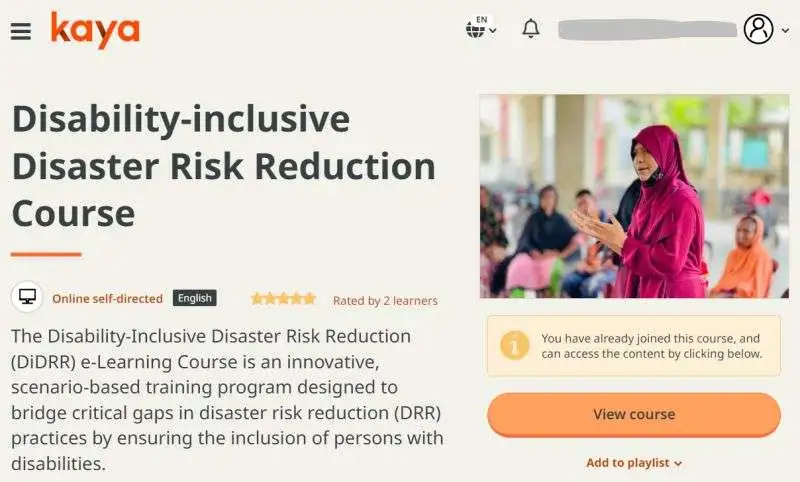
That gap is precisely what the Disability-Inclusive Disaster Risk Reduction (DiDRR) e-Learning Course exists to close — and the good news is that it is free, fully online, takes only 90 minutes to complete, and is open to every single person reading this article right now.
What Is the DiDRR e-Learning Course?
The DiDRR e-Learning Course is a free, self-paced online training programme hosted on Kaya Connect, the humanitarian learning platform run by the Humanitarian Leadership Academy. It was developed through a direct collaboration between three of the most credible voices in the field: CBM Global Disability Inclusion, the UN Office for Disaster Risk Reduction (UNDRR), and the African Disability Forum, with financial support from the Global Greengrants Fund.
That is not a minor detail. The fact that the African Disability Forum was a lead development partner means this course was not built for Africa from the outside, it was built with Africa’s disability community at the centre. The scenarios, the case studies, and the frameworks reflect African realities: community structures, governance gaps, and the specific barriers persons with disabilities face in African contexts during disasters and emergencies.
What Will You Learn?
The course is structured in modules that take you through the full landscape of disability-inclusive disaster risk reduction, from foundational concepts to practical application. By the time you complete it, you will be equipped to:
Understand the specific risks persons with disabilities face during disasters. This includes physical barriers to evacuation, exclusion from early warning systems, lack of accessible emergency shelters, and the compounded vulnerability faced by women and girls with disabilities or persons with multiple disabilities.
Develop and implement inclusive DRR strategies. The course moves beyond awareness into action, teaching participants how to design programmes, policies, and emergency plans that actively include persons with disabilities, not just mention them.
Advocate for policy and systemic change. Participants learn how to engage governments, UN agencies, and humanitarian organisations to prioritise disability inclusion in national and local DRR frameworks, including how to reference the Sendai Framework for Disaster Risk Reduction, the CRPD, and regional instruments.
Use a scenario-based learning approach. Rather than passive lectures, the course places you in real-world situations and challenges you to respond making the learning stick and directly applicable to your work on the ground.
Who Is This Course For?
The course was designed with a deliberately wide audience in mind, and that is one of its greatest strengths. It is relevant for:
Government officials and policymakers working in emergency management, civil protection, social protection, and disability affairs. If you are involved in writing national disaster preparedness plans, this course gives you the disability-inclusive lens you need.
Humanitarian workers and NGO staff who design and implement disaster response and recovery programmes. Understanding disability inclusion is increasingly a requirement, this course gives you the foundation and the certificate to prove it.
Representatives from Organisations of Persons with Disabilities (OPDs) who want to strengthen their advocacy capacity on DRR, or who are seeking to engage national emergency management bodies from a position of knowledge and evidence.
Civil society organisations working at the community level on resilience, climate adaptation, and emergency preparedness, particularly in disaster-prone regions of Africa.
Researchers, students, and academics studying disaster management, disability studies, development, or humanitarian affairs.
Community leaders who serve on local disaster risk management committees or want to make their communities safer and more inclusive for neighbours with disabilities.
If you fit any of those descriptions or if you simply care about making sure persons with disabilities are not left behind when disaster strikes, this course is for you.
Why This Matters Specifically for Africa
Africa faces some of the world’s highest exposure to disaster risk. Climate change is intensifying floods, droughts, cyclones, and extreme heat events across the continent. The Sahel is experiencing prolonged dry seasons that threaten food security. East and Southern Africa face recurrent cyclone damage. West African coastlines are increasingly vulnerable to flooding. The Horn of Africa is regularly in the grip of humanitarian crisis.
Across these scenarios, persons with disabilities face a disproportionate burden. They are more likely to live in precarious housing. They are more likely to depend on community support systems that break down during crises. They are more likely to be excluded from the cash transfers and emergency aid distributions that follow disasters. And they are almost universally excluded from the early warning systems that save lives.
The co-development of this course with the African Disability Forum signals a commitment to change that. The course reflects an understanding that DRR in Africa cannot be inclusive without the active leadership and participation of African disability organisations — and it equips those organisations to take that seat at the table.
The Certificate: Why It Matters for Your Organisation
Upon completing all modules, participants receive a downloadable certificate from CBM Global Disability Inclusion and UNDRR, two of the most widely respected names in the global disability and humanitarian sectors.
For OPD staff and civil society workers, this certificate serves multiple purposes. It demonstrates professional development to donors and partners. It strengthens CVs and grant proposals that reference capacity in disability-inclusive programming. It provides credible evidence for advocacy meetings with government officials. And it signals, collectively, that Africa’s disability community is trained, prepared, and ready to lead on DRR — not just to be consulted on it.
For organisations preparing to apply for funding in the humanitarian, climate, or disaster management space, having staff who hold this certification significantly strengthens your application.
How to Enrol – Step by Step
Enrolling in the DiDRR course takes less than five minutes. Here is exactly what to do:
- Go to the course page at: kayaconnect.org/course/info.php?id=11411
- Click “Register for free” at the top of the Kaya Connect platform if you do not already have an account. Registration is free.
- Once logged in, return to the course page and click “I agree — Join course.”
- You can start immediately, pause at any time, and return to where you left off. You do not need to complete it in one session.
- When you have completed all modules, download your certificate.
The whole process from registration to certification takes approximately 90 minutes of active learning time, plus a few minutes for account setup.
A Final Word: Training as Advocacy
In the disability rights movement, knowledge is power and visibility. Every person with a disability, every OPD staff member, every humanitarian worker, and every community leader who completes this course adds to the growing body of trained professionals pushing for a world where disaster preparedness is designed for everyone from the start, not retrofitted for disabled people as an afterthought.
Share this with your team. Share it with your government counterparts. Share it with the other OPDs in your network. The course is free. The time investment is 90 minutes. The impact, when multiplied across hundreds and thousands of trained individuals across Africa, is potentially life-saving.
Enrol today: kayaconnect.org/course/info.php?id=11411