

Disability Rights Fund 2026: How to Apply, Eligibility, Deadlines, and Webinars for Africa
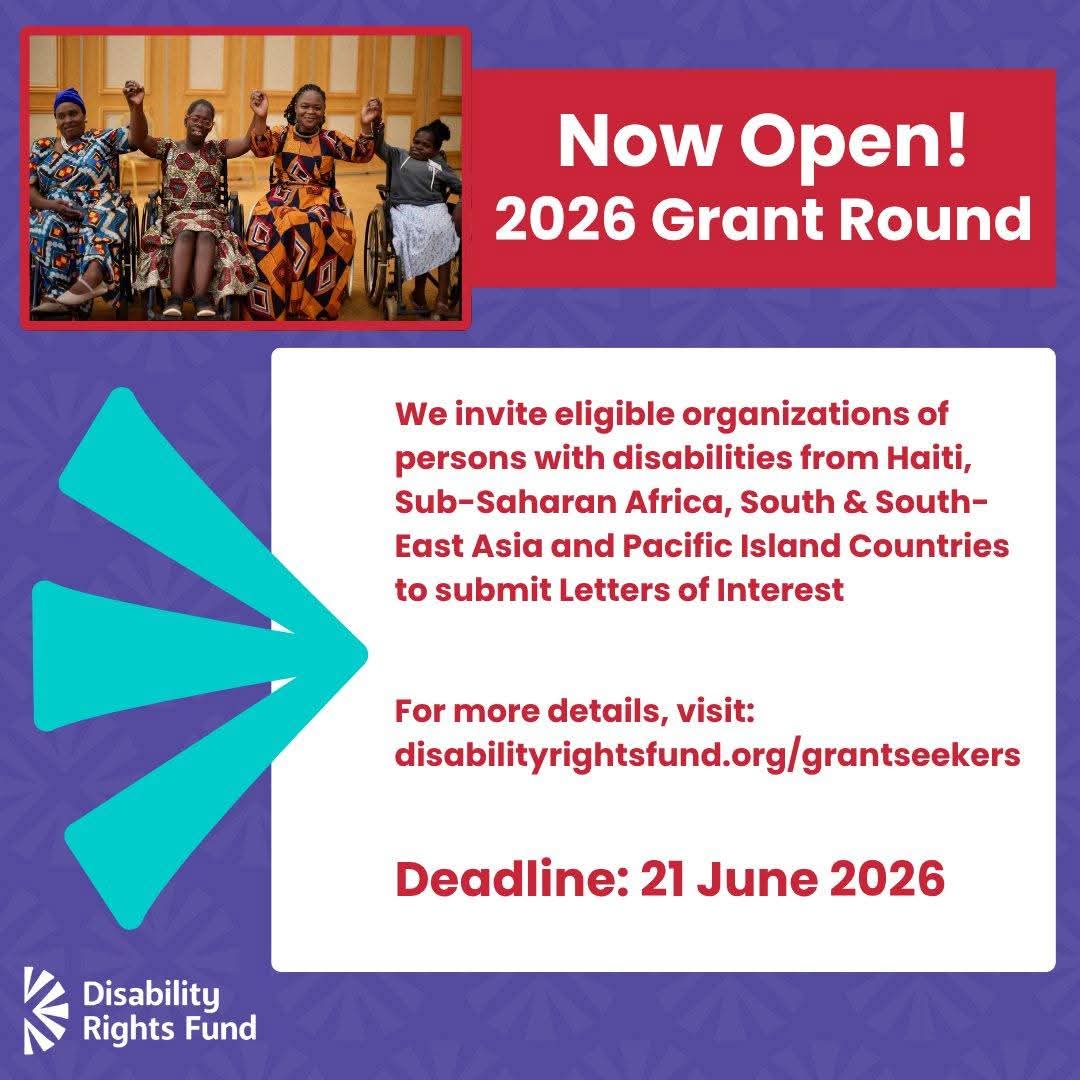
Status: Open Now | LOI Deadline: June 21, 2026 | Regions: Sub-Saharan Africa, South and South-East Asia, Pacific Island Countries | Funder: Disability Rights Fund (DRF)
The Disability Rights Fund has officially opened its 2026 grant round. The application portal is live today, and the deadline for submitting a Letter of Interest (LOI) is Sunday, June 21, 2026, at 23:59 EDT. That is 18 days from now. If your organization is a disability-led OPD based anywhere in Sub-Saharan Africa and you have been waiting for this window, it is open right now and you need to act immediately.
This post is your complete, step-by-step guide to the 2026 DRF grant round. It covers what DRF is, who qualifies, how much funding is available, what is new in 2026, the live webinar sessions you can register for this week, and exactly how to prepare a strong Letter of Interest before time runs out.
What Is the Disability Rights Fund?
The Disability Rights Fund was founded in 2008 and is one of the very few global grant-making institutions that exclusively funds organizations of persons with disabilities (OPDs). It does not fund governments, schools, hospitals, or service-delivery NGOs. It funds disability-led organizations that are doing advocacy, rights-based work, and systemic change on behalf of their communities.
DRF has a sister organization, the Disability Rights Advocacy Fund (DRAF), which focuses specifically on legislative lobbying. Together, DRF and DRAF have disbursed grants to hundreds of OPDs across Sub-Saharan Africa, South and South-East Asia, Haiti, and Pacific Island Countries since their founding. Every grant DRF has ever made is publicly listed in an open directory dating back to 2008, a level of transparency that is rare in the international development funding space.
What separates DRF from most funders is its governance model. Persons with disabilities are not positioned as beneficiaries at DRF. They are the decision-makers. The Grantmaking Committee that approves or rejects applications includes disability activists and movement leaders from the very regions DRF funds. This is a fund built by and for the disability rights movement, not a fund designed by outsiders looking in.
DRF’s 2026 strategic plan, titled Disability-Led Futures for a Just World, sets out a clear commitment to intersectional disability rights work, meaning the fund is actively seeking applications from OPDs that operate at the crossroads of disability justice and other movements including gender justice, LGBTQI+ rights, economic justice, climate justice, racial justice, youth rights, and Indigenous rights.
The 2026 Grant Round: What Is New and What Has Changed
The 2025 grant round was DRF’s first ever open call to all organizations across Sub-Saharan Africa, South and South-East Asia, and Pacific Island Countries, moving away from the previous model of funding only specific pre-selected countries. The response was overwhelming. DRF received close to 2,000 Letters of Interest in 2025 and was able to fund just over 150 grants, supporting disability rights work at local, national, and regional levels through 2026.
That expansion continues in 2026 with several important updates:
Coalition Structure Has Changed
In previous years, DRF offered distinct funding tracks labeled as Mid-level Coalition Grants and National Coalition Grants, each with their own budget ranges and requirements. In 2026, these separate coalition tracks no longer exist. All applications, whether submitted by a single OPD or by a coalition of multiple organizations, are now evaluated using the same criteria. Submitting as a coalition does not automatically result in a larger budget. This is a meaningful change that organizations planning to apply jointly need to understand before they structure their LOI.
Grant Amounts Are Under $50,000
Most grants awarded in the 2026 round will be under $50,000 USD and will cover 12 months of work, beginning January 1, 2027. This positions DRF grants in the small-to-medium funding category, making them accessible for grassroots and community-embedded organizations that would not typically meet the thresholds of larger institutional donors.
Organizations With Ending Multi-Year Grants Can Apply
If your organization holds an active multi-year DRF grant that is ending in December 2026, you are eligible to apply in this 2026 round. This was a common point of confusion in previous cycles and DRF has now explicitly confirmed it in their 2026 FAQ.
Full 2026 Grant Round Timeline
These are the confirmed official deadlines from the Disability Rights Fund:
- Portal opened for LOI submissions: Saturday, May 30, 2026
- Deadline to submit your Letter of Interest (LOI): Sunday, June 21, 2026 at 23:59 EDT (Eastern Daylight Time — New York and Port-au-Prince time)
- Invitations to successful applicants: Tuesday, July 28, 2026
- Deadline for full applications (invited organizations only): Sunday, August 23, 2026
- Final grantmaking decisions: December 2026
- Successful projects start: January 1, 2027
Note that the LOI deadline of June 21 uses Eastern Daylight Time. For African organizations, this translates as follows: West Africa (WAT, UTC+1) means midnight on the night of June 21 to 22. East Africa (EAT, UTC+3) means 02:59 on the morning of June 22. Central Africa (CAT, UTC+2) means 01:59 on June 22. Do not wait until the final hours. Submission portals can experience high traffic close to deadlines.
Who Is Eligible to Apply
DRF has clear and firm eligibility requirements. Before you spend time preparing a Letter of Interest, confirm that your organization meets all of the following criteria:
Your Organization Must Be an OPD
DRF defines an Organization of Persons with Disabilities (OPD) as an organization where the majority of its staff, volunteers, and/or board members are persons who identify as people with disabilities and/or their family members. If persons with disabilities are not in the majority in your governance and operational structure, you do not qualify as a lead applicant. You may still be a coalition partner, but the lead organization on any application must be an OPD under this definition.
Your Organization Must Be Based in an Eligible Region
The 2026 open call is for organizations based in Sub-Saharan Africa, South and South-East Asia, Pacific Island Countries, and Haiti. All 54 countries of Africa that fall within the Sub-Saharan geographic scope are eligible. This includes West, East, Central, and Southern Africa.
You Must Be a Registered Organization or Have a Fiscal Sponsor
Your organization must be a registered non-governmental entity. If your organization is not formally registered, you can still apply through a fiscal sponsor. A fiscal sponsor is a registered NGO or community-based organization that agrees to receive and disburse the DRF grant funds on your behalf. If you go this route, you must include specific additional documentation in your application (detailed in the section below on fiscal sponsors).
Governments, Schools, and Universities Cannot Apply
DRF does not fund governmental entities, public schools, or public universities under any circumstances. It also does not fund individuals, private for-profit businesses, or organizations whose primary work is service provision or income generation rather than rights-based advocacy.
What DRF Does Not Fund
This section is critical. Many organizations in Africa do excellent disability-related work but fall outside DRF’s funding mandate. Understanding what DRF will not fund saves you time and allows you to redirect your energy to funders that match your work.
DRF does not fund: capital construction projects or projects specifically to make buildings physically accessible; service provision programs, including healthcare delivery, income generation, or skills training for individual livelihood improvement; legislative lobbying (this falls under DRAF, DRF’s sister fund); scholarships or funding for conference attendance and training; emergency or rapid-response grants; and individual activists, even if they are engaged in disability rights work.
If your organization’s primary activity is running therapy services, providing assistive devices, constructing accessible facilities, or running vocational training programs, DRF is not the right funder. Organizations doing this kind of work should look at CBM Global, Light for the World, or government disability grant schemes in their respective countries.
What DRF Does Fund
DRF funds rights-based advocacy and systemic change work led by OPDs. Concretely, this means organizations working on any or several of the following types of activities are well positioned to apply:
Campaigns to advance the implementation of the UN Convention on the Rights of Persons with Disabilities (CRPD) at national or local level; coalition-building among OPDs and between OPDs and other civil society movements; influencing government policy on disability rights through research, evidence-based advocacy, and community organizing; legal empowerment work that helps persons with disabilities understand and claim their rights; building the institutional capacity of OPDs to sustain long-term disability rights movements; and cross-movement work that connects disability justice to gender rights, climate justice, economic rights, or other intersecting struggles.
For organizations working at the intersection of disability and gender, disability and youth rights, or disability and climate justice, DRF’s 2026 strategic priorities make this a particularly strong cycle to apply.
General Operating Support: Who Can Apply for It
DRF offers a General Operating Support (GOS) grant track, which allows eligible organizations to use funding for their core institutional operations rather than a specific project. However, not all organizations qualify for GOS. To be considered, your organization must meet all of the following additional criteria beyond standard OPD eligibility:
- Have a demonstrated track record of successful disability rights advocacy
- Have diverse and representative membership that reflects the communities of persons with disabilities you serve
- Have disability-representative leadership at both staff and board level
- Demonstrate meaningful collaboration within and across disability organizations
- Have established cross-movement connections with evidence of successful cross-movement work
- Have visibility and recognition among government authorities, community members, and other civil society organizations
- Be a repeat DRF grantee with a consistent record of respecting donor reporting requirements and deadlines
If your organization is applying to DRF for the first time in 2026, you are not eligible for General Operating Support. First-time applicants apply for project-specific grants only.
Applying as a Coalition: What You Need to Know in 2026
As noted above, the dedicated Mid-level and National Coalition grant tracks no longer exist in 2026. However, coalitions of multiple organizations are still welcome and encouraged to apply jointly. The key rules for coalition applications are as follows:
The majority of organizations in the coalition must be OPDs, meaning disability-led organizations under DRF’s definition. The lead applicant or managing partner of the coalition must itself be an OPD. Non-OPD partners, such as human rights organizations or media entities, are permitted as minority coalition partners. Submitting as a coalition does not guarantee a higher grant amount than a single-organization application.
Organizations considering a coalition application should be realistic about the coordination demands. Coalition grants require shared reporting, joint financial management, and clear delineation of responsibilities. These structures are only worth building if the coalition reflects genuine partnerships that existed before the grant opportunity arose, not partnerships of convenience assembled to meet a deadline.
Applying With a Fiscal Sponsor
If your organization is not formally registered as an NGO, you can still apply by identifying a registered organization to act as your fiscal sponsor. The fiscal sponsor must be a registered non-governmental or community-based organization that is legally able to receive international funds and that agrees to disburse the funding to your group.
If you are applying through a fiscal sponsor, your LOI and subsequent full application must include: proof of legal registration of the fiscal sponsor; a copy of the fiscal sponsor’s incorporation documents or constitution; a signed Memorandum of Understanding between your organization and the fiscal sponsor that outlines the financial and operational relationship; the fiscal sponsor’s organizational background, key personnel, and contact information; and the bank account details of the fiscal sponsor based in the country of incorporation.
Finding and formalizing a fiscal sponsorship arrangement takes time. If you need to go this route, begin those conversations immediately. Waiting until the final week before the June 21 deadline to secure a fiscal sponsor is not realistic.
Free Information Webinars: Register Now
DRF is hosting a series of free virtual information sessions to help organizations understand the 2026 grant round, ask questions directly to DRF staff, and get guidance on completing the Letter of Interest. These sessions are region-specific and are happening this week and next week. Register as soon as possible as spaces may fill up.
East and West Africa (English)
Date: Thursday, June 4, 2026
Time: 2:00 PM WAT (UTC+1)
Registration: Click here to register
Francophone Africa and Haiti (French)
Date: Thursday, June 4, 2026
Time: 10:00 AM EDT (UTC-4)
Registration: Click here to register
Central and Southern Africa (English)
Date: Monday, June 8, 2026
Time: 10:00 AM CAT (UTC+2)
Registration: Click here to register
Indonesia and Timor Leste (Bahasa Indonesian)
Date: Tuesday, June 9, 2026
Time: 9:00 AM WIT (UTC+7)
Registration: Click here to register
South and South-East Asia (English)
Date: Monday, June 8, 2026
Time: 11:00 AM BST (UTC+6)
Registration: Click here to register
Pacific Island Countries (English)
Date: Thursday, June 4, 2026
Time: 11:00 AM WST (UTC+13)
Registration: Click here to register
DRF has also made an LOI User Guide available as a downloadable PDF. You can access it directly at: DRF 2026 LOI User Guide (PDF)
How to Access the Application Portal
The application portal is live now. You can submit your Letter of Interest directly through DRF’s official grant management system here: Access the DRF 2026 Application Portal
Create your account, begin your LOI early, and save your progress regularly. Do not wait until June 20 to log in for the first time. Online grant portals frequently experience technical difficulties in the final days before a deadline, and DRF is unlikely to grant extensions due to last-minute technical issues on the applicant’s side.
How to Write a Strong Letter of Interest
The Letter of Interest is the first filter in DRF’s selection process. Organizations whose LOIs are shortlisted will be invited to submit a full application by August 23. Organizations not invited after the LOI stage will not proceed further. Given that DRF received close to 2,000 LOIs in 2025 and funded only around 150 organizations, the LOI stage is genuinely competitive. Here is how to give yours the best possible chance.
Ground Everything in the CRPD
DRF requires that funded work reference and support the UN Convention on the Rights of Persons with Disabilities. This is not optional language. Your LOI should identify the specific CRPD articles most relevant to your proposed advocacy work and explain clearly how your project advances those articles at the local, national, or regional level. Organizations that frame their work in general disability welfare terms without connecting it explicitly to rights obligations under the CRPD are less likely to be shortlisted.
Demonstrate That Your Organization Is Genuinely Disability-Led
DRF’s reviewers are experienced disability rights practitioners. They can tell the difference between an organization that is genuinely governed and staffed by persons with disabilities and one that serves persons with disabilities without meaningfully including them in leadership. Your LOI should be explicit about the composition of your board, your senior staff, and your general membership. If your executive director is a person with a disability, say so. If a majority of your board members have disabilities, say so. If your organization was founded by persons with disabilities to advocate for their own rights, make that founding story clear and early in your narrative.
Be Specific About the Change You Are Working Toward
Vague advocacy language does not make a strong LOI. Instead of writing that your organization works to promote the rights of persons with disabilities, describe what specific policy change, legal outcome, or systems-level shift your proposed project is working toward, in which country or region, targeting which institutions, using which advocacy methods. The more concrete and measurable your theory of change, the more credible your application appears to a review committee composed of experienced disability rights practitioners.
Connect to Intersecting Movements If Relevant
DRF’s 2026 strategic priorities explicitly call out intersectional work. If your organization works with women with disabilities, young people with disabilities, LGBTQI+ persons with disabilities, or disability communities affected by climate vulnerability or economic exclusion, make those intersections visible in your LOI. This is not about adding checkboxes. It is about being honest about the complexity of the communities you serve and how your advocacy reflects that complexity.
Be Honest About Your Organization’s Capacity
One of the fastest ways to lose credibility in a DRF review is to present an organizational profile that is inconsistent with your proposed budget and activities. If your organization has an annual budget of $15,000 and you are proposing a $48,000 project, your LOI needs to address how you will manage that scaling. If your organization is applying to DRF for the first time, acknowledge it and highlight what demonstrated experience in advocacy work you do have, even if not previously funded by DRF.
Languages Accepted
DRF accepts Letters of Interest and full applications in four languages: English, French, Bahasa Indonesian, and Portuguese. Organizations based in Francophone Africa can submit in French. Organizations in Lusophone Africa, including Mozambique, Angola, Cape Verde, Guinea-Bissau, and Sao Tome and Principe, can submit in Portuguese. There is no need to translate your application into English if your team works primarily in French or Portuguese.
Key Questions and Answers from DRF’s 2026 FAQ
The following are direct clarifications from DRF’s official 2026 Frequently Asked Questions, which Able Path Africa has paraphrased here for your convenience:
Do you provide emergency grants? No. DRF does not currently have rapid response or emergency grant opportunities.
Who qualifies for a regional grant? Regional grants are open to organizations registered at the regional level that are actively operating in more than three countries.
Can we apply for General Operating Support if we are a first-time applicant? No. General Operating Support is only available to repeat DRF grantees with a consistent compliance record.
Can a non-OPD be part of our coalition? Yes, non-OPD partners such as human rights organizations or media organizations are permitted as minority members of a coalition, but the lead applicant and the majority of coalition members must be OPDs.
Do all coalition partners need to submit their own LOIs? No. The lead organization submits a single coalition LOI on behalf of all partners.
Can we apply if we already have an active multi-year DRF grant ending in December 2026? Yes. Organizations with grants ending in December 2026 are explicitly eligible to apply in the 2026 round.
Additional Resources
- Official DRF Grantseekers Page: www.disabilityrightsfund.org/grantseekers
- DRF Application Portal (Live Now): Access the portal here
- LOI User Guide (PDF): Download the guide
- DRF Strategic Plan — Disability-Led Futures for a Just World: Read the plan
- DRF Past Grantmaking Directory: View past grants
- DRAF (Sister Fund for Legislative Lobbying): drafund.org
The Bottom Line for African OPDs
The Disability Rights Fund 2026 grant round is open right now. The portal is live. Webinars are happening tomorrow and next week. The LOI deadline is June 21. There are 18 days left.
DRF is not a fund you apply to on the last day. The organizations that succeed in competitive grant rounds like this one are the ones that begin early, read the guidance carefully, ground their proposals in the CRPD, tell honest and specific stories about their advocacy work, and submit before the servers get overloaded in the final hours.
If your organization is disability-led, based in Sub-Saharan Africa, and doing rights-based advocacy work, this is one of the most aligned funding opportunities available to you anywhere in the world right now. Share this post with every OPD leader and disability rights advocate you know. The movement grows when the information reaches the right people in time.
All information in this post is sourced directly from the official Disability Rights Fund website at disabilityrightsfund.org, last verified June 3, 2026. Able Path Africa is an independent disability news and opportunities platform and is not affiliated with or endorsed by the Disability Rights Fund. Always verify deadlines and requirements directly with the funder before submitting.