
Africa IFI Community Grants 2026: Up to £1,500 for Education Projects — Here Is How Disability Organisations Running Inclusive Education Work Can Apply
Important Transparency Note for Our Readers
We want to be upfront with you before you read further: the Africa IFI Community Grants 2026 programme, run through the Cloud Chef Grant Programme under the Africa Impact Finance Initiative, is not a disability-specific grant. It does not target OPDs or disability organisations as a priority group. Its focus is broad community-based education projects across Africa.
However, disability organisations working in inclusive education — special needs education, early childhood development for children with disabilities, literacy programmes for deaf learners, vocational training for young adults with disabilities, or school accessibility improvement — can and should apply. The eligibility criteria do not exclude disability organisations, and education-focused OPDs have a strong natural fit with this grant’s mission.
We are including this grant on AblePath Africa because the disability community in Africa is chronically underfunded in the education space, the application process is relatively straightforward, and the deadline is imminent. We want you to have the full picture so you can make an informed decision.
What Is the Africa IFI Community Grants Programme?
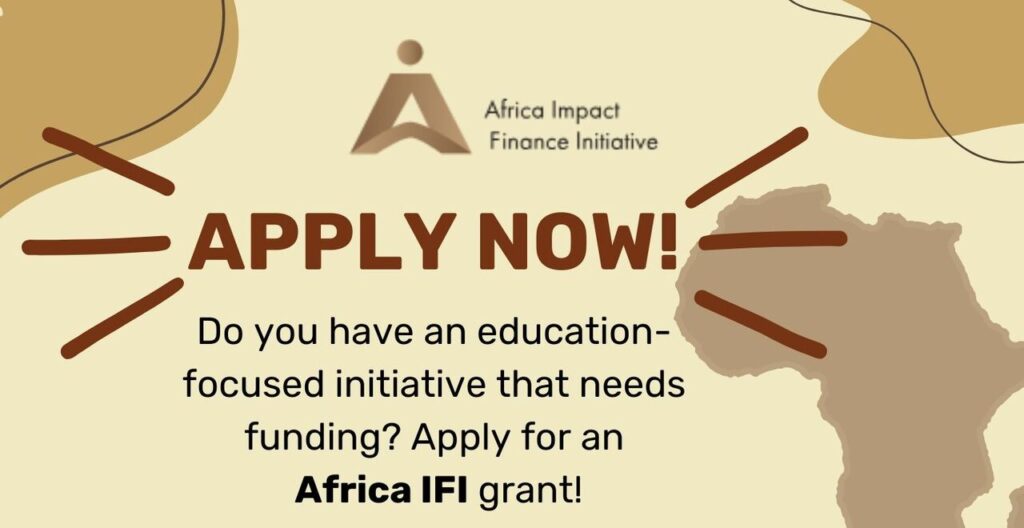
The Africa IFI Community Grants 2026 is an initiative run by the Africa Impact Finance Initiative (IFI), delivered through the Cloud Chef Grant Programme. It is designed to support community-based organisations across Africa that are working to improve educational outcomes for children and young adults up to the age of 25.
The programme operates on a belief that local, community-rooted solutions are the most effective driver of educational change — particularly in contexts where formal government systems are under-resourced or geographically inaccessible. Rather than funding large institutional players, the programme prioritises grassroots organisations with direct community ties and evidence of genuine local engagement.
Grants of up to £1,500 are available per project. While this is a modest amount, it can be meaningfully transformative for small community-based disability organisations that lack access to international donor networks.
Who Is Eligible?
To qualify for an Africa IFI Community Grant, your organisation must meet the following criteria:
Geographic scope: Your organisation must operate within an African country. This covers all 54 countries on the continent.
Project focus: Your proposed project must aim to improve education for children or young adults up to the age of 25. For disability organisations, this translates directly to inclusive education, special needs education, learning support, or vocational training programmes targeting young people with disabilities.
Operational track record: Your organisation must have been active for at least 12 months before applying. Brand new organisations that have not yet completed a full year of operations are not eligible.
Community-based approach: The programme requires that your organisation demonstrates strong ties to the community it serves. For disability OPDs, the community-based disability services model is a natural fit here.
Why Disability Organisations Working in Inclusive Education Are a Strong Fit
Education remains one of the most acutely underfunded and overlooked areas of disability inclusion across Africa. The statistics are stark: fewer than 10% of children with disabilities in Africa attend school, according to World Bank estimates. Those who do access education often do so in environments that are physically inaccessible, staffed by teachers with no disability-inclusive training, and using curricula and materials that do not accommodate diverse learning needs.
Disability organisations across the continent are already filling this gap — running schools for children with visual or hearing impairments, delivering inclusive education workshops in mainstream schools, providing assistive technology to learners, training special education teachers, and supporting parents of children with disabilities to advocate for their children’s educational rights.
These are precisely the types of community-rooted, education-focused activities the Africa IFI Community Grants was created to fund. The disability education gap in Africa is an education gap — and this grant targets the education gap.
If your organisation runs any of the following, you should consider applying:
- Inclusive education support programmes for children with disabilities
- Special needs schools or learning support centres
- Literacy programmes for deaf learners using sign language
- Early childhood development programmes targeting children with developmental disabilities
- Training programmes for teachers on inclusive education or special needs education
- Vocational training or skills development for young adults with disabilities (up to age 25)
- Assistive technology provision for learners with disabilities
- Community awareness campaigns targeting parents and schools on disability and educational inclusion
What the Grant Can Fund
The Cloud Chef Grant Programme explicitly supports projects that contribute to educational development and empowerment. Funded initiatives are expected to demonstrate clear educational impact and strong community engagement.
For disability organisations, this could mean funding for:
- Teaching and learning materials adapted for learners with specific disabilities (Braille textbooks, large-print resources, sign language training materials)
- Travel and logistics for community-based teachers or special needs educators
- Small equipment purchases directly tied to learning outcomes (hearing loop systems, tactile learning materials)
- Parent and community engagement activities that improve educational inclusion
- Documentation and evidence collection for your education programme
The key principle is that funds must be used for project activities, not for salaries or general operational costs. Plan your budget accordingly.
How to Apply
The application process is conducted entirely online. Here is what you need to do before the 13 April 2026 deadline:
- Visit the official application link: https://tinyurl.com/2435j5ve
- Review the full eligibility criteria and programme guidelines carefully before beginning your application.
- Prepare a clear project description that explains: who you serve, what educational challenge you are addressing, how your project will address it, and how you will measure impact.
- Demonstrate your community ties — letters from community leaders, partnerships with schools or local government, or participant numbers from previous programmes are all useful here.
- Prepare a simple budget showing how the grant funds will be used.
- Submit before the deadline. Incomplete or late applications will not be reviewed.
Given the proximity of the deadline (13 April 2026), if you are considering applying, you need to begin today.
Honest Assessment: Is This Worth It for Disability Organisations?
£1,500 is a small grant by international funding standards. It will not transform an organisation or fund a major programme. But for small, community-based disability education groups in Africa, particularly those operating without any existing donor relationships, it offers several things that have value beyond the cash:
It creates a track record of receiving and managing international grants, which is critical evidence for applying to larger funders.
It provides unrestricted funds for project activities that are difficult to fund from domestic sources.
It builds a documented project with measurable outcomes that can be cited in future funding applications to larger bodies.
It connects your organisation to the Africa Impact Finance Initiative network, which may lead to further opportunities.
For organisations that are genuinely small, genuinely grassroots, and genuinely working on disability and education in Africa, this grant is worth the application effort. For larger, more established OPDs with access to international donor relationships, the time investment may be better directed at larger funding opportunities.
Apply honestly and strategically, and make sure your proposal clearly articulates the disability education need you are addressing and the measurable change your project will create.