
Ghana Ratifies AU Convention on Violence Against Women as Disability Federation Demands Full Inclusion
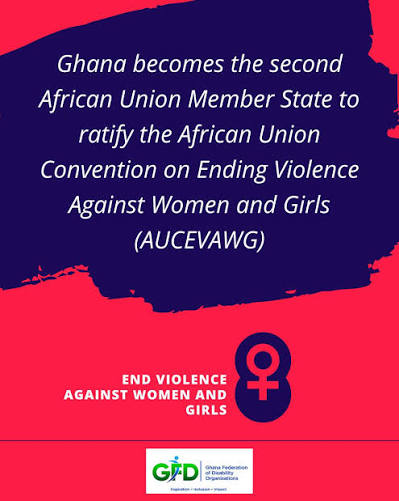
Ghana has taken a major step in the fight against violence against women and girls by ratifying the African Union Convention on Ending Violence Against Women and Girls (AUCEVAWG).
The development makes Ghana only the second African Union member state, after The Gambia, to ratify the landmark continental convention. Ghana’s Parliament approved the ratification by resolution on July 30, 2026, according to the African Commission on Human and Peoples’ Rights.
But disability advocates are warning that the significance of the milestone will depend on whether women and girls with disabilities are fully included in the Convention’s implementation.
The Ghana Federation of Disability Organisations (GFD) has welcomed the ratification while calling for meaningful participation of women and girls with disabilities and their representative organisations in the process.
A Landmark African Treaty
The AUCEVAWG is the African Union’s first continental legal instrument dedicated specifically to ending violence against women and girls in both public and private spheres.
The African Commission described Ghana’s ratification as a significant milestone in advancing women’s rights and addressing structural patterns of violence and discrimination across Africa.
The Convention was adopted by the African Union in 2025 and is designed to establish a continent-wide framework for prevention, protection, prosecution and coordinated action against violence.
However, ratification is only one stage of the process.
The African Commission has stressed that Ghana must still deposit its ratification instrument with the African Union and take the necessary legislative and institutional steps required for effective implementation.
Why Disability Inclusion Cannot Be Left Out
For women and girls with disabilities, the risks associated with violence can intersect with other forms of discrimination.
Physical barriers, communication barriers, stigma and inaccessible services can make it harder for survivors to report abuse, access healthcare, obtain legal assistance or seek protection.
The GFD has therefore argued that women and girls with disabilities must be actively involved in the implementation of the Convention rather than treated as a separate or secondary consideration.
That means disability organisations should have a meaningful role in designing, implementing and monitoring national measures.
The Accessibility Problem
A law or convention cannot protect a survivor who cannot access the system intended to help them.
Consider a Deaf woman attempting to report violence to a police station without access to sign-language interpretation.
Or a woman with a physical disability trying to reach a service centre located in an inaccessible building.
Or a woman with a visual impairment receiving critical information in a format she cannot read.
These are not theoretical barriers.
They demonstrate why gender-based violence policies must also be disability-inclusive.
GFD Calls for Meaningful Participation
The Ghana Federation of Disability Organisations has called for women and girls with disabilities and their representative organisations to be actively consulted and meaningfully involved in the development, implementation, monitoring and evaluation of measures arising from the Convention.
This is particularly important because disability organisations bring knowledge that cannot be replaced by policy assumptions.
Women with disabilities understand the barriers they encounter in healthcare facilities, police stations, courts, shelters and community services.
Their participation can therefore improve the practical design of Ghana’s response.
Ghana’s Ratification Comes at a Continental Moment
Ghana’s decision comes as the African Union works to encourage more countries to sign and ratify the Convention.
The African Union has stated that the Convention requires 15 ratifications before it can enter into force. As of the AU’s May 2026 roadmap, eight countries had signed the instrument.
Ghana’s ratification therefore has significance beyond its own borders.
It could encourage other African governments to move from signature to ratification and help accelerate the Convention’s entry into force.
From Ratification to Implementation
The next stage will be critical.
Ghana will need to translate the Convention’s obligations into national systems, policies and programmes.
For disability inclusion, this should include:
- Accessible reporting mechanisms
- Accessible shelters and support services
- Sign-language interpretation
- Accessible information
- Disability-inclusive police training
- Inclusive healthcare services
- Accessible justice systems
- Data that identifies disability-related barriers
- Participation of women with disabilities in policy monitoring
Without these measures, ratification risks remaining largely symbolic.
A Wider Lesson for Africa
Ghana’s experience also highlights a broader issue for African policymaking.
Disability inclusion should not be added to gender policies after they have already been designed.
It should be considered from the beginning.
Women with disabilities are women first, but they can also encounter disability-specific barriers that require targeted solutions.
A genuinely inclusive gender policy therefore has to recognise these overlapping realities.
Why This Matters for Women and Girls with Disabilities
Violence can have devastating consequences for any survivor.
For women and girls with disabilities, the consequences can be compounded by dependence on caregivers, social isolation, communication barriers and difficulties accessing justice.
That makes effective protection particularly important.
The AUCEVAWG provides Ghana with an opportunity to strengthen its response while ensuring that nobody is excluded from protection because of disability.
Conclusion
Ghana’s ratification of the African Union Convention on Ending Violence Against Women and Girls is an important continental milestone.
But for women and girls with disabilities, the real significance will be determined by what happens next.
The Ghana Federation of Disability Organisations is right to place inclusion at the centre of the implementation conversation.
If women and girls with disabilities are meaningfully involved, and if accessibility is built into protection, healthcare, justice and prevention systems, Ghana can turn ratification into practical protection.
The country’s leadership could then extend beyond becoming only the second AU member state to ratify the Convention.
It could demonstrate what genuinely disability-inclusive action against violence looks like.