
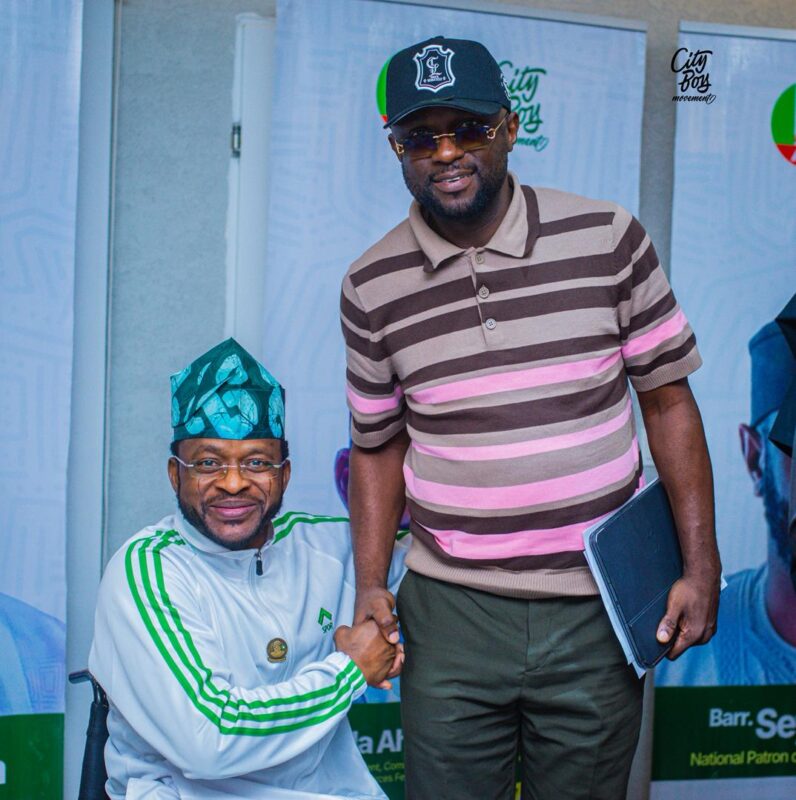
City Boy Movement Names Mohammed Abba Isa to Lead PWD Mobilisation: What It Means When Grassroots Politics Finally Meets Disability Rights
For most of Nigeria’s political history, the 35 million Nigerians who live with disabilities have occupied a familiar position in the country’s political landscape: they appear in party manifestos as a group to be served, they are mentioned in speeches as a constituency to be considered, and then they are largely absent from the rooms where decisions are made, the committees where policies are drafted, and the party structures through which political mobilisation actually happens.
The City Boy Movement’s decision to appoint Mohammed Abba Isa to lead its persons with disabilities (PWD) mobilisation structure is interesting precisely because it represents an attempt to change this pattern at the level of grassroots political organizing, which is where change in Nigeria’s political landscape almost always begins. Whether this appointment produces the substantive shift it implies will depend on how it is resourced, how it is connected to the disability organizations that actually represent persons with disabilities, and whether the political commitments it signals translate into anything measurable in the lead-up to 2027. But the structural move itself is significant enough to examine carefully.
Who Is Mohammed Abba Isa: A Profile of Nigeria’s Most Prominent Disability Rights Official
Mohammed Abba Isa is not a newcomer to disability advocacy. He holds a Bachelor’s degree in Public Administration with honours from the University of Maiduguri, where he also completed a Master’s in Public Administration in 2017. More importantly, he brings over a decade of field-level experience in both local and international disability advocacy, making him one of the most credentialed individuals working on disability inclusion within Nigeria’s public administration structure.
In November 2023, President Bola Ahmed Tinubu approved his appointment as the Senior Special Assistant to the President on Disability Matters. The formal announcement, made through the State House, described Abba Isa as a distinguished champion of persons with disabilities with extensive experience in advocacy work on their behalf. His appointment came with a specific mandate from the President: to proactively create avenues of opportunity for inclusion by embedding PWD requirements and perspectives into the policies and programmes of all Ministries, Departments, and Agencies of the Federal Government.
The President additionally charged him with working closely with sub-national authorities, the 36 state governments and the Federal Capital Territory, to build a national consensus on PWD-friendly policy and environmental conditions, working in collaboration with the National Commission for Persons with Disabilities. This is a broad mandate. It essentially positions the Senior Special Assistant as a disability mainstreaming officer for the entire federal executive structure, with the authority to engage any ministry or agency on how its programmes affect persons with disabilities and to push for changes where those programmes fall short.
In practice, Abba Isa has used this role to engage across multiple government domains. He has met with the Ministry of Youth Development to ensure that young persons with disabilities are included in national youth policy conversations. He has presented progress reports on the federal government’s disability inclusion commitments. He has compiled official documentation of Nigeria’s disability inclusion track record through his office, including the document titled “Nigeria’s Commitment to Disability Inclusion 2024,” which outlines the government’s stated strides in the area. Through his Beyond Disability Project, he has articulated a vision of disability empowerment that goes beyond welfare provision into talent development and job creation, with stated ambitions to empower thousands of talented persons with disabilities and generate tens of thousands of employment opportunities at implementation scale.
What Is the City Boy Movement and How Does It Work
To understand what Abba Isa’s appointment within the City Boy Movement means, it is necessary to understand what the City Boy Movement is and how it operates within Nigeria’s political landscape.
The City Boy Movement was established in 2022, initially as a youth advocacy and mobilisation platform aligned with support for Bola Tinubu’s presidential ambition ahead of the 2023 general elections. Since President Tinubu’s election, the Movement has evolved into a broad grassroots political mobilisation network with a claimed presence across all 36 states and 774 local government areas of Nigeria. Its leadership includes Barr. Seyi Tinubu, son of the President and patron of the Movement, and Francis Oluwatosin Shoga, who serves as Director-General. The Movement is explicitly youth-focused, positioning itself as a platform that bridges the gap between political leadership and young Nigerians, encouraging civic participation, voter education, and engagement with government policies at the grassroots level.
In 2026, the City Boy Movement has been actively deepening its organizational infrastructure ahead of the 2027 general election cycle. A strategic meeting in March 2026 formally approved the full structure of a Women Wing, designed to operate at national, state, and local government levels and to position women as the backbone of grassroots political mobilisation. Regional tours have been conducted in the South-South, beginning in Edo State, with the Edo State Governor Monday Okpebholo welcoming the Movement as a recognition of the state’s growing relevance in national political engagement. The Movement has also been expanding its presence in Oyo State and other politically strategic locations.
This context is important because it shows the City Boy Movement as a structurally serious and politically connected grassroots organization that is actively building out its organizational architecture across demographic and geographic dimensions. The addition of a PWD mobilisation structure, led by Abba Isa, follows the same organizational logic as the Women Wing: it is an attempt to formalize engagement with a specific constituency as a deliberate strategic and organizational priority, not merely a rhetorical nod in a policy document.
Why Disability Mobilisation in a Political Movement Matters
The history of disability politics in Nigeria has been characterized by a consistent structural problem: the disability community has significant numbers but limited political organization. With an estimated 35 million Nigerians living with disabilities, the potential political constituency is substantial. But translating that population size into political leverage requires the kind of organized, ward-level, voter registration-focused, candidate-identifying, accountability-demanding work that political movements do well and that disability NGOs, whose primary expertise is in service delivery and rights advocacy, often do not have the infrastructure to execute.
Political mobilisation and policy advocacy are related but different activities. Policy advocacy, which JONAPWD, the NCPWD, and many civil society organizations do well, involves engaging government institutions, participating in policy dialogues, making representations to legislators, and monitoring implementation of legal obligations. This is essential work. But it is upstream work. It shapes the conditions in which political decisions are made. Political mobilisation happens downstream: it identifies voters, gets them registered, ensures they can access polling stations, motivates them to participate, identifies potential candidates from within the community, and builds the political relationships through which elected officials are pressured to keep their commitments.
A disability community that is organized at the ward level, that has relationships with local government officials, that can turn out voters and hold politicians accountable at the constituency level, is a different political force than a disability community whose advocacy is concentrated at the national level in Abuja. Abba Isa’s appointment within the City Boy Movement is, at minimum, an attempt to build that kind of ward-level organizational presence for persons with disabilities as a political constituency.
What Genuine PWD Mobilisation Would Look Like
The value of this appointment will ultimately be judged by the specificity and substance of what the PWD mobilisation structure actually does. There are several things that a genuine PWD mobilisation effort, rather than a nominal one, would need to accomplish.
It would need to engage disability organizations, OPDs, and community-based groups as genuine partners in the design and execution of the mobilisation effort, rather than treating them as a passive constituency to be organized from the outside. The City Boy Movement’s approach to disability mobilisation will be far more effective if it is co-designed with the organizations that already have relationships of trust within disability communities across Nigeria’s six geopolitical zones.
It would need to address the specific barriers that persons with disabilities face in political participation: inaccessible polling stations, voter education materials that are not available in accessible formats, the absence of sign language interpretation at political events, and the economic marginalization that makes it difficult for persons with disabilities to participate in time-intensive civic activities. Political mobilisation that does not address these barriers will reach only the most advantaged segment of the disability community and leave out the many who face the greatest barriers.
It would need to result in concrete political commitments from the APC and from President Tinubu’s administration on the specific disability policy demands that organizations like JONAPWD have been articulating. Mobilisation without commitment extraction is activity without accountability. The City Boy Movement’s PWD mobilisation structure would demonstrate its seriousness by making specific asks: disability representation in the 2026/27 budget, accessible government services, implementation of the Discrimination Against Persons with Disabilities Act, and appointments of persons with disabilities to positions of authority across federal agencies and parastatals.
And it would need, over the medium term, to identify and support persons with disabilities who are candidates for elected office, providing them with the organizing infrastructure, the voter contact systems, and the political relationships that make the difference between a candidacy that generates awareness and a candidacy that wins. Nigeria’s disability community has talent and leadership capacity in abundance. What it has historically lacked is the organized political machinery to convert that capacity into electoral outcomes.
Connecting the Appointment to the Broader Political Moment
Abba Isa’s appointment within the City Boy Movement does not happen in isolation. It coincides with a broader moment of increased political attention to disability inclusion in Nigeria. The GDS Commitments Action Plan, detailed in a separate Able Path Africa report from the June 3 media roundtable, has created a public accountability framework for Nigeria’s disability commitments. The legislative conversation around a 2 percent revenue allocation for disability inclusion is underway. JONAPWD and other organizations are pushing hard on the implementation deficit across multiple government domains.
In this environment, a grassroots political movement that formalizes disability mobilisation as an organizational priority is not just adding a structural unit to its organogram. It is adding weight to a broader accountability ecosystem. Persons with disabilities who are engaged politically through the City Boy Movement’s PWD structure are also constituents who can be mobilized to attend JONAPWD’s public advocacy events, to contact their legislators about disability budget allocations, and to vote in 2027 for candidates who have made specific, accountable disability inclusion commitments.
The movement between these different domains of engagement, from grassroots political mobilisation to rights-based policy advocacy to electoral participation, is how disability communities in other parts of the world have built political power. It is slower than a single dramatic policy win, but it is more durable. And it is what Mohammed Abba Isa’s appointment, if it is backed by genuine resources and genuine commitment, has the potential to contribute to in Nigeria.
Sources: City Boy Movement Nigeria; Office of the Senior Special Assistant to the President on Disability Matters; Blueprint Newspapers; Voice of Nigeria; Statehouse.gov.ng; Nigeriascorecard; Leadership Newspaper; Vanguard Nigeria. Note: Readers are encouraged to follow official City Boy Movement communications channels for further details on the scope and operational structure of this appointment. Able Path Africa is an independent disability news and opportunities platform.