
CBM Global: How African Disability Organisations Can Become Partner Organisations and Access Sustainable Programme Support
Most conversations about disability funding in Africa focus on grant competitions with fixed windows, competitive eligibility criteria, and application processes that favour larger or better-resourced organisations. These routes matter, but they are not the only route.
CBM Global operates differently. It works through long-term local partnerships, choosing to embed its resources into the structures of existing disability organisations and build their capacity over time rather than offering one-off project grants. For African disability organisations that are serious about sustainable growth, CBM Global is one of the most important international partners to understand.
This post explains exactly who CBM Global is, what kinds of organisations it partners with in Africa, what the partnership means in practice, and how an African disability organisation can begin the process of becoming a CBM Global partner.
Who Is CBM Global?
CBM Global Disability Inclusion is an international development and humanitarian organisation with over 115 years of experience working alongside people with disabilities in some of the world’s poorest communities. It operates across 29 countries in Africa, Asia, the Pacific, and Latin America, supporting local partner organisations to deliver inclusive community-based programmes.
CBM Global’s vision is an inclusive world in which all people with disabilities enjoy their human rights and achieve their full potential. Its mission is to fight to end the cycle of poverty and disability, working with the most marginalised communities in low and middle-income countries.
CBM Global currently supports over 206 local partner organisations globally and has reached 80.2 million people across Africa, Asia, and Latin America. These numbers are significant. CBM Global does not operate standalone programmes. Everything it does is delivered through local partner organisations, which means local partners are not just recipients of support but the primary vehicles through which CBM Global achieves its mission.
What CBM Global Does in Africa
CBM Global’s programming in Africa spans five interconnected areas:
Community-Based Inclusive Development (CBID) CBM Global supports inclusive development at the community level, working to remove the barriers that prevent persons with disabilities from accessing health, education, livelihood opportunities, and civic life. This is done in direct partnership with local organisations and Organisations of Persons with Disabilities.
Inclusive Eye Health CBM Global’s oldest programme area focuses on preventing avoidable blindness and ensuring that people with permanent vision impairment can access support and opportunities. CBM recently launched a new ear and hearing care project in Meru County, Kenya, expanding its work into hearing health as well.
Community Mental Health CBM Global supports community mental health programmes across Africa, Asia, and Latin America, recognising that mental health is central to the wellbeing and inclusion of persons with disabilities. This includes psychosocial support, self-help groups, peer support structures, and mental health system strengthening at national level.
Inclusive Education CBM Global supports access to inclusive quality education for children with disabilities across its programme countries, addressing the deep exclusion of disabled children from school systems across the continent.
Livelihoods and Economic Inclusion CBM Global works with local partners to improve employment and self-employment opportunities for persons with disabilities, recognising that economic exclusion is one of the most persistent consequences of disability in African contexts.
Advocacy CBM Global works from community to global level to influence laws, policies, and practices in favour of disability inclusion. It works with governments, UN agencies, development banks, and other international organisations, and it supports its OPD partners to engage in national and regional advocacy.
The CBM Global Partnership Model
CBM Global explicitly states that it believes its mission can only be achieved through partnership. The organisation has published a formal Partnership Approach that governs how it works with local organisations, built around six partnership principles: mutual respect and trust, listening and responding to partner priorities, long-term allyship, shared accountability, complementarity, and respectful communications.
Three things make CBM Global’s partnership model distinctive:
It is long-term. CBM Global does not offer short-term project grants. It invests in sustained relationships with local organisations that are often measured in years, not months. Partner organisations are supported not just to implement specific activities but to become stronger, more sustainable institutions.
It prioritises OPDs. CBM Global has committed that at least 20 percent of its funding to partners goes directly to OPD partners. The organisation has a formal commitment made at the 2025 Global Disability Summit to increase the number of programmes that include OPD organisational strengthening components by 25 percent. This signals that CBM Global is actively looking for more OPD partners, not fewer.
It is guided by “nothing about us without us.” CBM Global takes the disability movement’s founding principle seriously. Its advisory approach is grounded in the expertise of people with disabilities themselves. OPD partners are treated as implementers, influencers, and advocates, not merely as beneficiaries of technical support.
What Kinds of Organisations Does CBM Global Partner With in Africa?
CBM Global partners with a wide range of organisations, not exclusively OPDs. Its partner network includes:
Local NGOs and CBOs working on disability, health, rehabilitation, or inclusive development at community level. Organisations of Persons with Disabilities, both at national and sub-national levels. Government health, education, and rehabilitation institutions in programme countries. Research and academic institutions working on disability and inclusive development. Regional disability federations and networks.
The types of work CBM Global prioritises in its African partnerships include community-based rehabilitation, inclusive eye health, community mental health, inclusive education, livelihoods for persons with disabilities, advocacy for disability-inclusive laws and policies, and humanitarian response with disability inclusion mainstreamed.
CBM Global is also co-leading, with the International Disability Alliance and the Disability Rights Fund, the Disability Rights and Climate Justice Board, which makes grants to OPDs in Sub-Saharan Africa and other regions working on climate justice and disability. This board has already awarded over USD 300,000 in grants to 31 OPDs across Sub-Saharan Africa, South-East Asia, the Pacific Islands, Latin America and the Caribbean, and Europe.
How to Approach CBM Global as a Potential Partner
CBM Global does not have a standing open call for new partners in the way that some grant-making foundations do. Its partnership development is strategic, context-specific, and typically initiated through direct engagement with CBM Global country teams or regional offices.
Here is how an African disability organisation should approach the process:
Step 1: Understand CBM Global’s country presence in Africa. CBM Global operates across 29 countries globally, with significant presence in Africa. Its African programme countries have included Nigeria, Zimbabwe, Ethiopia, Kenya, Uganda, Ghana, Malawi, Mozambique, Tanzania, Zambia, South Africa, and others. The best starting point is to find out whether CBM Global has a country team in your country by visiting cbm-global.org and navigating to their country or regional programme pages.
Step 2: Contact the CBM Global country office directly. If CBM Global has a country presence in your country, the most effective path is to contact the country team directly and introduce your organisation. Explain what you do, who you serve, and what areas of work you believe align with CBM Global’s mission. Country teams have the most contextual understanding of local needs and are best placed to assess whether a partnership could be beneficial.
Step 3: If there is no country office in your country, engage through the regional or global level. For organisations in countries where CBM Global does not yet have a country programme, it is worth reaching out through CBM Global’s global website at cbm-global.org using their contact form, or connecting with CBM Global through regional disability networks such as the African Disability Forum.
Step 4: Align your work with CBM Global’s thematic priorities. CBM Global is most likely to partner with organisations working in community-based inclusive development, eye health, mental health, inclusive education, livelihoods for persons with disabilities, or advocacy. Organisations should be clear about how their work connects to one or more of these areas when making an initial approach.
Step 5: Demonstrate the “nothing about us without us” principle in your own governance. CBM Global places great weight on meaningful participation of persons with disabilities in leadership, governance, and decision-making within partner organisations. Before approaching CBM Global, organisations should be able to articulate clearly how persons with disabilities are represented in their leadership and how they influence programme decisions.
What Partnership Support Looks Like in Practice
CBM Global partner organisations in Africa typically receive a combination of financial support for programme implementation, capacity strengthening support including training, mentoring, and organisational development, technical advisory support through CBM Global’s Inclusion Advisory Group, access to learning and resource materials, and integration into CBM Global’s wider advocacy networks.
CBM Global also produces a range of free resources that any African disability organisation can access immediately, even before any formal partnership is established. These include guidance notes for OPDs on engaging with development and humanitarian actors, toolkits on inclusive eye health, community mental health, and disability-inclusive climate action, and practical guides on inclusive MHPSS in humanitarian emergencies. All of these are available at cbm-global.org/about-us/learning-and-resources.
The Disability Rights and Climate Justice Board: An Open Grant Opportunity
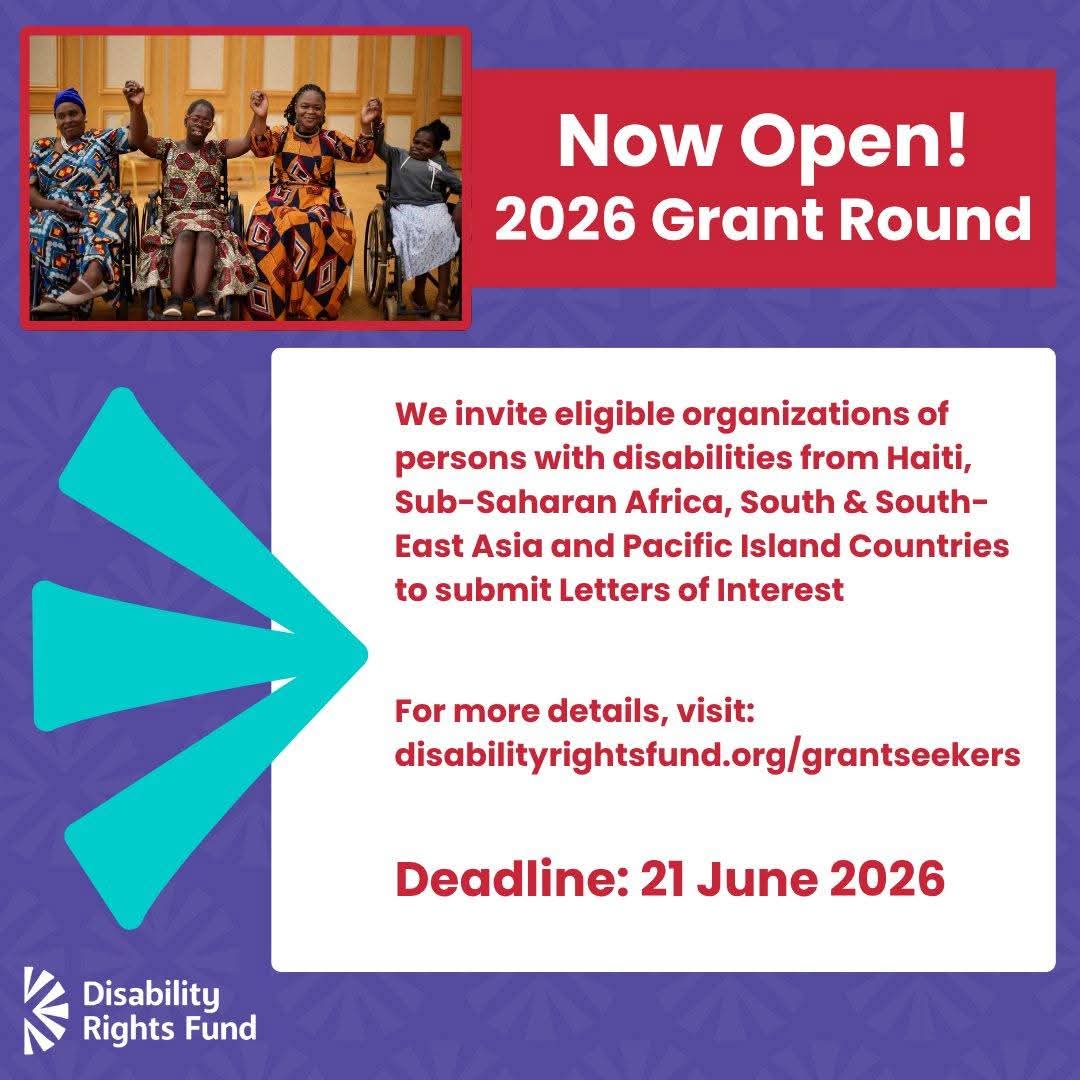
One specific and currently active funding opportunity connected to CBM Global is the Disability Rights and Climate Justice Board (DRCJ), which CBM Global co-leads with the International Disability Alliance and the Disability Rights Fund. This board makes grants to OPDs working at the intersection of disability rights and climate justice. It has already completed its first year of grant-making, awarding over USD 300,000 to 31 OPDs across multiple regions. African OPDs working on climate justice, environmental advocacy, or the impacts of climate change on communities with disabilities should follow developments from the DRCJ Board closely. Monitor updates at cbm-global.org and through the Disability Rights Fund’s website at disabilityrightsfund.org.
Why CBM Global Matters to African Disability Organisations in 2026
The disability inclusion landscape in Africa is changing rapidly. The African Disability Protocol has entered into force. National disability laws are being strengthened in multiple countries. Global funders are paying more attention to African disability organisations than at any previous point in history. In this context, having CBM Global as a partner carries significant strategic value beyond the direct financial and technical support it provides.
CBM Global’s reputation, networks, and influence with governments and international bodies can open doors for partner organisations that would otherwise remain closed. Its commitment to long-term allyship means that the relationship grows stronger over time rather than ending when a grant cycle closes.
For African disability organisations that are serious about building sustainable institutional capacity while expanding their advocacy reach, beginning the conversation with CBM Global is one of the most valuable steps they can take in 2026.
Start at cbm-global.org.