
Disability Justice Fund for Women Uganda, Ghana and Tanzania 2026: The Complete Guide to This Groundbreaking Grant
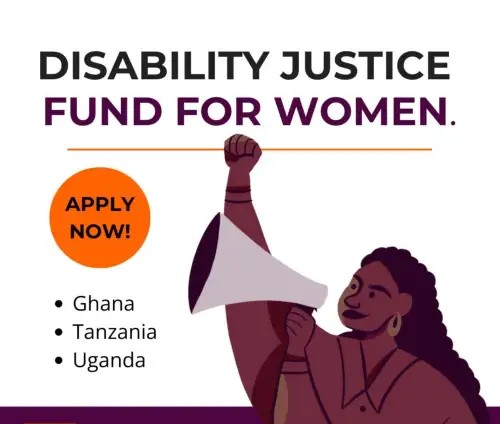
Most funding programmes are designed for women with disabilities. The Disability Justice Fund for Women is different. It was designed by them. That single distinction makes this one of the most important and most meaningful grant opportunities available to disability-led organisations in Uganda today, and if your organisation works with or is led by women with disabilities, this is a guide you need to read in full.
In this post, we cover everything: what the fund is, where it comes from, how much money is available, who qualifies, what activities it supports, which Ugandan organisations have already received grants, and how you can apply. We also explain the African Disability Protocol, the human rights treaty at the centre of this fund, because understanding it is key to building a strong application.
What Is the Disability Justice Fund for Women?
The Disability Justice Fund for Women (DJFW) is a grant programme administered by ADD International, an organisation that has worked in disability inclusion across Africa and Asia for decades. The fund was created specifically for grassroots organisations and groups led by women with disabilities in three countries: Ghana, Tanzania, and Uganda.
What sets it apart from most international disability grants is its origin story. Rather than being designed by funders in a boardroom, the DJFW was co-created by women disability activists from the three target countries. These women came together to determine the fund’s priorities, identify the most marginalised groups it should reach, define the thematic areas it should cover, and shape the application process to be genuinely accessible for small organisations that often struggle with complex donor requirements.
One of the Ugandan women involved in designing the fund described it as a golden opportunity to create a grant that speaks directly to the specific needs of women and girls with disabilities, something she said had never happened before in her experience of international funding. That spirit is baked into every aspect of how the fund works.
The African Disability Protocol: Why This Fund Exists
To understand the Disability Justice Fund for Women, you need to understand the African Disability Protocol (ADP). The ADP is a landmark human rights treaty adopted by the African Union specifically to address the rights of persons with disabilities on the African continent. It builds on the United Nations Convention on the Rights of Persons with Disabilities but goes further by addressing issues unique to the African context.
This includes explicit protections against harmful cultural practices that disproportionately affect persons with disabilities in Africa, such as associations with witchcraft, ritual killings, abandonment by families, and deliberate concealment of children with disabilities from public life. These are not abstract concerns. They are documented realities that affect PWD communities across Uganda and the wider region.
Uganda is among the countries that have committed to the ADP framework. The DJFW is specifically built to fund organisations doing the work of advancing, advocating for, and raising awareness about the ADP at the community level, because the protocol only delivers results when people know it exists and know how to use it.
Why Women With Disabilities in Uganda Need This Fund
The case for targeting funding specifically at women with disabilities in Uganda is built on data that is difficult to ignore. According to the national census, approximately 5.5 million Ugandans live with a disability, representing around 13.2 percent of the population. More than 3 million of those are women. Disability prevalence among women in Uganda stands at 15 percent, compared to 10 percent among men.
Yet women with disabilities remain among the most consistently excluded groups from development programming, economic opportunity, political participation, and justice systems. Research shows that nearly 64 percent of women with disabilities in Uganda report experiencing physical, sexual, or emotional violence in their lifetime, significantly higher than the figure for women without disabilities. Access to education, healthcare, employment, and legal protection is limited by both gender discrimination and disability-related barriers simultaneously.
International funding has historically flowed to larger, better-connected organisations, leaving the small grassroots groups doing the most direct community work without the resources they need to sustain and scale their impact. The DJFW was created precisely to correct that imbalance.
How Much Money Is Available?
The DJFW offers two grant sizes, designed to accommodate both very small community groups and more established organisations.
The small grant is available to both registered and unregistered groups. Unregistered groups can apply for this tier and will need to provide two referees as part of the application. There is no minimum operating history required for the small grant.
The large grant of up to $20,000 USD is available to registered organisations that have been operating for at least two years. This tier requires formal registration and a more detailed application, but the process has been deliberately kept simpler and more open than most international grant applications.
Applications can be submitted in Local currencies, removing the burden of currency conversion from applicants and making the financial planning process more practical for locally based groups.
What Activities Does the Fund Support?
The DJFW supports a broad range of activities, as long as they align with at least one of the priority thematic areas identified by the women who designed the fund. There are no rigid prescriptions about how much must be spent on which category of activity. Applicants are trusted to determine how the funding should be used, including for operational and running costs that most institutional grants prohibit.
Supported activities include building understanding of and doing advocacy on the African Disability Protocol and related disability policies. The fund supports skills development in advocacy and rights-based approaches for women and girls with disabilities. It supports the mobilisation of women and girls with disabilities for collective action and movement building. It funds work that encourages collaboration between women with disability organisations and broader civil society and human rights movements. It supports activities that improve accessibility and inclusion for the most marginalised groups. And it supports organisational development work that builds the financial sustainability and governance of disability-led groups.
Income generation activities are also eligible, meaning organisations working on economic empowerment alongside rights work can include those components in their proposals.
Who Is Eligible to Apply in Uganda, Ghana or Tanzania?
The fund is open to organisations and groups led by women with disabilities based in any of these three countries. The leadership requirement is clear: at least half of the group’s leaders, or board members where a formal board exists, must be women with disabilities.
Citizenship is not required. Refugees and non-citizens who are resident are fully eligible to apply. This is a deliberate decision that extends the fund’s reach to displaced women with disabilities living in significant refugee communities.
The fund explicitly prioritises the following target groups, identified by the women who helped design it:
- The most marginalised women with disabilities, particularly those facing multiple overlapping forms of exclusion
- Women with disabilities living in rural and hard-to-reach areas across Uganda, Ghana and Tanzania
- Girls and young women with disabilities aged between 12 and 35 years
- Women with disabilities who have limited formal education or literacy
- Grassroots disability organisations whose members operate at the community level
- Older women with disabilities aged above 65 years
If your organisation works primarily with or within any of these groups, your application will be treated as a priority by the selection committee, which itself includes women with disabilities from the target countries.
Ugandan Organisations That Have Already Received DJFW Grants
Understanding who has already been funded gives a clear picture of the types of organisations the DJFW is designed to support. The first cohort of Ugandan grantees includes organisations that are small, deeply rooted in their communities, and doing work that most international funders have never encountered.
Inclusi Talk is a group of digital disability activists running a feminist online platform to inform, educate, and amplify the voices of persons with disabilities. Shamim, the group’s Team Lead, described the experience of receiving the grant as unexpected and transformative for a group that had just celebrated its first birthday when it applied. Inclusi Talk used the grant to provide digital skills training for women and girls with disabilities, addressing what they identified as a critical and overlooked dimension of disability exclusion in Uganda.
Empower Her Disability Network Uganda runs an annual leadership and mentorship camp for young women and girls with disabilities. Programme Director and Co-Founder Josephine, who has mentored women and girls with disabilities for over ten years, described the organisation’s mission as producing self-empowered advocates who can fight for disability justice themselves. The DJFW grant is funding advocacy and awareness programmes centred on educating PWDs about the African Disability Protocol and their rights under Ugandan law.
Bududa District Hard of Hearing Association, based in Eastern Uganda, focuses on creating awareness about disability and promoting the rights of women with hearing impairment. Their project under the DJFW, named Uplift the Rural Voice for Women and Girls With Disabilities, aims to amplify the voices of women and girls with hearing impairments in rural areas through community mobilisation, dialogue with local leaders, and rights education.
Kyenjojo Women with Hard of Hearing Association, based in Western Uganda, works on capacity building, advocacy, and creating safe spaces for women with hearing impairment. Chairperson Caroline described receiving the grant as a huge milestone, noting it was the first time the organisation had ever received external funding. The grant is supporting advocacy training on disability policies and community dialogues with local leaders about hearing impairment and inclusion.
How to Apply for the Disability Justice Fund for Women in Uganda, Ghana or Tanzania
Applications are submitted online through the ADD International website. For groups that cannot access the online form, a downloadable version of the application can be submitted by email to disabilityjusticewomen@add.org.uk or by WhatsApp to +254 735 486754. This dual-channel approach is another example of how the fund has been designed with accessibility as a genuine priority rather than an afterthought.
The application form itself is intentionally simpler and more open than standard grant applications. There are no prescribed budget ratios, no mandatory spending categories, and no complex reporting templates to navigate at the point of application. You are asked to describe what you want to do and why, and to outline how the funding will be used. The process is designed to favour clarity and purpose over administrative sophistication.
Grant decisions are made jointly by the ADD International team and by women with disabilities, ensuring that the selection process reflects the same participatory values as the fund’s design.
To check the current application status, get notified about the next open round, and access the application form, visit add.org.uk/djfw-2. If you have concerns about safety or confidentiality during the application process, ADD International can be reached directly at disabilityjusticewomen@add.org.uk.
What Makes This Fund Different From Other Disability Grants in Uganda, Ghana or Tanzania
Most grants available to disability organisations in these countries come with significant conditions attached. They require formal registration, multi-year track records, detailed log frames, and rigid budget structures that reflect donor priorities more than community realities. They are designed by people who are not disabled, for people who are, and the distance between those two positions consistently shapes which organisations get funded and which do not.
The DJFW inverts that dynamic. By involving women with disabilities in every stage of the fund’s design, it has produced a grant mechanism that is more accessible in its application process, more relevant in its thematic focus, more flexible in its use of funds, and more honest about who it is trying to reach. For small Ugandan organisations doing real community work with minimal resources, that difference is not marginal. It is the difference between qualifying and not qualifying, between applying with confidence and not applying at all.
If your organisation is led by women with disabilities and is doing work to advance the rights and dignity of women and girls with disabilities in Uganda, Ghana or Tanzania, the Disability Justice Fund for Women is built for you. Do not wait for the next round to find you. Go and find it.
Visit add.org.uk/djfw-2 to learn more and register your interest today.
It’s a good initiative and we as support organization of parents with disabilities, working with mother’s with disabilities and their children pray that at one time we can be funded by this