Parish Development Model Uganda: How Persons With Disabilities Can Access Their 10 Percent Government Allocation in 2026
There is money set aside for persons with disabilities in every single parish in Uganda. It is government money, it is backed by a presidential directive, and it is available right now. Yet in many districts across the country, the majority of eligible persons with disabilities have never received a single shilling of it. This post explains exactly what the Parish Development Model (PDM) PWD allocation is, how much is available, how to access it, what is standing in the way, and what you need to do to claim what is legally yours.
What Is the Parish Development Model?
The Parish Development Model (PDM) is the Ugandan government’s flagship poverty reduction and economic transformation programme, launched in 2022 under President Yoweri Museveni. Its core idea is to push economic development resources directly to communities at the parish level, which is the smallest administrative unit in Uganda’s governance structure and the unit closest to citizens in their daily lives.
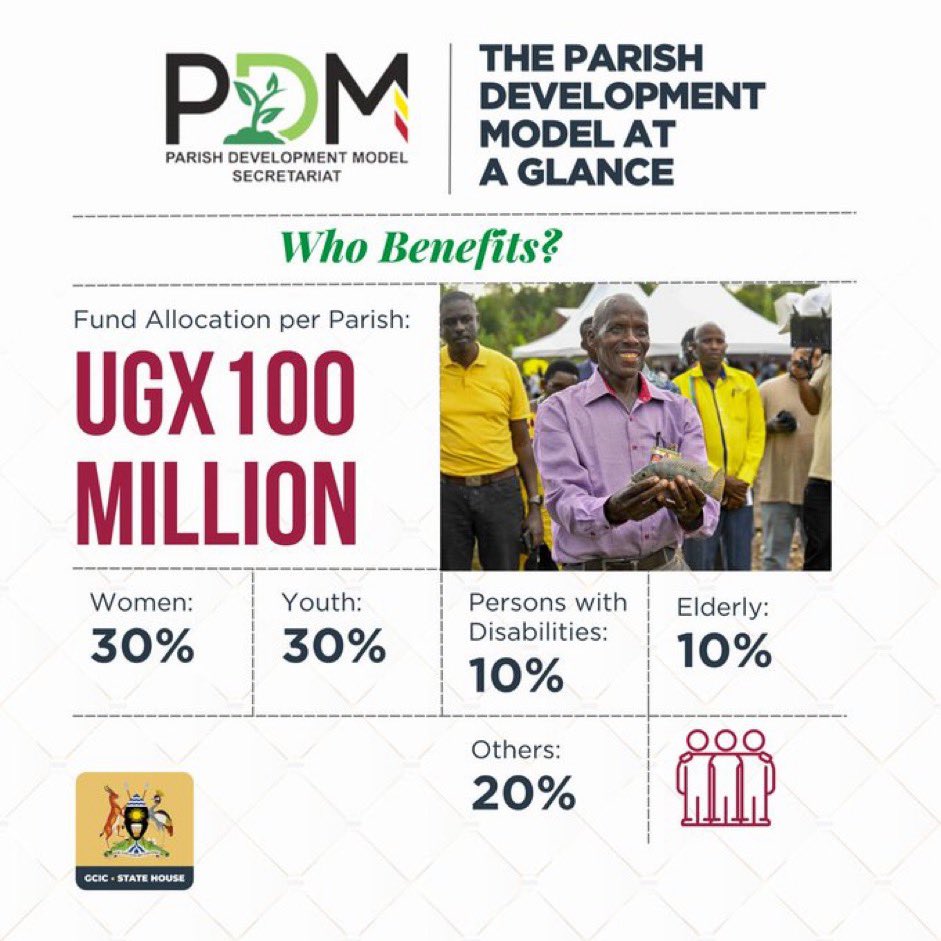
Rather than waiting for development to trickle down from national programmes, the PDM positions each parish as its own economic planning hub. Every parish in Uganda receives 100 million Ugandan Shillings annually under the programme. These funds are channelled through Parish Development Model SACCOs (savings and credit cooperatives) that are established in each parish. Enterprise groups are formed within those SACCOs, and members access loans to invest in agricultural value chains, small businesses, and other income-generating activities. Loans are issued at a five percent interest rate, with repayment terms set by the enterprise group itself.
The PDM targets the approximately 39 percent of Uganda’s population still operating in the subsistence economy. Since its launch, the government has disbursed over $239 million in loans through the PDM SACCO network across the country, making it one of the largest grassroots economic interventions in Uganda’s history.
The PWD Allocation: What Persons With Disabilities Are Entitled To
Within the PDM framework, the Ugandan government has established a formal allocation specifically for persons with disabilities. This is not an informal arrangement or a pilot programme. It is a standing policy commitment that applies to every parish in the country.
Ten percent of every parish’s annual 100 million shilling PDM disbursement is reserved for persons with disabilities. That means 10 million Ugandan Shillings per parish per year is designated for PWDs. Across Uganda’s thousands of parishes, the cumulative value of this reservation is enormous. It represents one of the most significant government commitments to disability inclusion in Uganda’s recent history, not through a new law or a new ministry, but through direct financial allocation at the grassroots level.
Beyond the 10 percent reservation, the government introduced an additional benefit specifically for PWD beneficiaries. At the launch of Uganda’s Global Disability Summit (GDS) Commitments in September 2025, State Minister for Disability Affairs Ms Hellen Asamo announced that PWDs who are PDM beneficiaries will receive an additional non-refundable Shs 500,000 on top of the standard Shs 1 million enterprise loan.
This brings the total PDM benefit for a PWD household to Shs 1.5 million. Of that amount, Shs 1 million is a repayable loan at five percent interest, and Shs 500,000 is a non-refundable grant that does not need to be paid back under any circumstances.
Why the Non-Refundable Shs 500,000 Matters
The reasoning behind the extra Shs 500,000 grant reveals something important about how the government has begun to think about disability inclusion in economic programming. Minister Asamo explained that the President specifically acknowledged that persons with disabilities face unique operational challenges when running a business or enterprise that non-disabled beneficiaries do not face.
A blind person running a market stall may need to hire someone to assist with navigation and transactions. A person with physical impairment may need to pay for transportation of goods that a non-disabled person could manage independently. A person with a hearing impairment may need to pay for communication support when dealing with suppliers or customers. These costs are real, they are disability-specific, and they are the reason many PWDs who receive standard PDM loans struggle to make those loans work for them in the same way other beneficiaries do.
The Shs 500,000 is described officially as a reasonable accommodation grant. It is designed to cover those additional costs without increasing a PWD beneficiary’s debt burden. This is a meaningful policy step, and it reflects an understanding of disability inclusion that goes beyond simply including PWDs in an existing programme and actually adapting the programme to fit their reality.
Since 2019, the government has disbursed a total of Shs 36 billion in direct support to PWD enterprises under various programmes, benefiting 55,805 households across Uganda.
Step-by-Step: How to Access PDM Funds as a Person With a Disability
Many eligible PWDs are not accessing PDM funds because the pathway into the programme is unclear. Here is the process broken down into practical steps.
Step 1: Get your National Identification Card. A valid National ID issued by the National Identification and Registration Authority (NIRA) is a non-negotiable requirement for entering the PDM system. Without it, you cannot be verified as a beneficiary or register with a parish SACCO. If you do not have a National ID, contact your local NIRA office or reach out to a district disability union, as several have signed agreements with NIRA to facilitate registration for PWDs at centralised locations, including provisions for those who have limited fingerprint functionality and require next-of-kin assistance for biometric registration.
Step 2: Attend your parish village meetings. Verification of eligibility happens at village-level meetings convened by the Parish Development Council. At these meetings, community members confirm who qualifies as a subsistence economy household. You need to be present, identified, and recorded as a PWD beneficiary at these meetings for your name to enter the system. If you are unaware of when these meetings are scheduled, contact your local Parish Chief or the Sub-County Community Development Office.
Step 3: Join or form a PWD enterprise group. The PDM operates through enterprise groups. Organising with other persons with disabilities in your parish creates a dedicated group within the SACCO structure, increases your collective visibility to SACCO officials, and builds the mutual accountability structure the programme expects. A PWD-specific enterprise group also makes it easier to advocate collectively when access is being denied.
Step 4: Access your funds through the parish SACCO. Once your enterprise group is registered with the SACCO, loan and grant applications are processed through that SACCO. The Shs 1 million loan and the Shs 500,000 non-refundable accommodation grant are both channelled through this mechanism. Your SACCO chairperson should be able to walk you through the documentation required at this stage.
Step 5: Connect with your district disability organisation. District Disabled Persons Unions, NUDIPU, and UNAPD member associations can provide guidance, link you to the formal programme structures, and advocate on your behalf if you are being excluded. Do not try to navigate the system alone if you have access to organised disability support in your district.
The Harsh Reality: Why Most PWDs Are Still Not Accessing PDM Funds
The 10 percent allocation exists in policy. The problem is that policy and practice are far apart. Reporting from Gulu City and Gulu District, published in late 2025, makes this gap impossible to ignore. Despite the formal 10 percent reservation, only around five percent of eligible PWDs in Gulu City’s 32 wards had actually accessed PDM funds at the time of reporting. In Gulu District’s 47 parishes, the figure was even lower, with just two to five PWDs benefiting per parish.
The barriers driving these numbers are well documented. The most significant is the National ID problem. Many persons with disabilities do not hold valid National IDs, either because the biometric fingerprint registration process cannot accommodate people with certain physical disabilities, or because NIRA registration points are physically inaccessible. Without an ID, a PWD cannot be formally registered in the PDM system at all.
Beyond the ID issue, there are bureaucratic barriers at the local government level. The processes for registering with a SACCO, attending verification meetings, and submitting enterprise group documentation can be opaque and difficult to navigate, particularly for people with visual, cognitive, or hearing disabilities without adequate support. There are also attitudinal barriers. Reports from the field consistently describe discriminatory attitudes among some local officials and SACCO administrators, who question whether persons with disabilities can run viable enterprises or manage loans responsibly.
And critically, there is a knowledge gap. Many PWDs across Uganda simply do not know that a 10 percent PDM allocation exists, that they are legally entitled to it, or how the process works. The programme has not been communicated in accessible formats or through the channels that reach disability communities most effectively.
What Is Being Done to Fix the Access Problem
Disability organisations are not waiting for the government to solve the access problem on its own. In Gulu, the Gulu Disabled Persons Union (GDPU) has signed a Memorandum of Understanding with NIRA specifically to facilitate National ID registration for PWDs in the district. The MOU includes provisions for next-of-kin fingerprint assistance for PWDs who cannot complete standard biometric registration due to their disability. GDPU is also conducting a systematic profiling exercise to compile accurate data on all PWDs in the area, noting that the 2024 national census significantly underreported the actual PWD population and that inaccurate data leads directly to inadequate resource allocation.
At the national level, the launch of Uganda’s Global Disability Summit commitments in September 2025 brought together government ministries, international partners, and disability organisations to agree on a multi-sectoral plan for implementing disability inclusion across all government programmes. The introduction of the Shs 500,000 non-refundable accommodation grant was announced at that same event, signalling that the government is at least willing to adapt the PDM framework in response to disability-specific feedback.
The National Council for Persons with Disabilities (NCD) is the primary government body responsible for monitoring the implementation of disability inclusion commitments. If you have been denied PDM access that you are legally entitled to, the NCD is the appropriate escalation point at the national level.
Other Government Programmes PWDs in Uganda Can Access
The PDM is not the only government channel through which persons with disabilities can access financial support. Two other programmes are worth knowing about.
The Emyooga Programme is a presidential initiative that provides enterprise group funding to specific categories of Ugandans, and persons with disabilities are one of the designated beneficiary categories. Emyooga funds are channelled through SACCOs in the same way as PDM funds and can be used for business startup and growth.
The Uganda Women Entrepreneurship Programme (UWEP) targets women-led enterprises across the country. Women with disabilities are eligible to access UWEP funding, making it a complementary channel to the PDM allocation for female PWDs looking to build or grow income-generating activities.
Both programmes are administered through district and sub-county Community Development Offices. Contact your local Community Development Officer for details on how to access them in your area.
What to Do If You Are Being Denied Access
If you are a person with a disability who meets the eligibility criteria for the PDM PWD allocation but is being denied access, you have recourse. Document the denial in writing if possible, noting the name of the official or SACCO representative involved, the date, and what was communicated to you. Report the issue to your District Community Development Officer, who has oversight responsibility for PDM implementation in your area.
If the district level does not resolve the issue, escalate to the National Council for Persons with Disabilities in Kampala. You can also reach out to your district Disabled Persons Union or to NUDIPU for support in navigating the complaint process.
The 10 percent reservation is not a suggestion. It is government policy. The money is there. Persons with disabilities in Uganda have a legal right to it, and that right should be asserted, supported, and protected at every level.
The Bottom Line for Persons With Disabilities in Uganda
The Parish Development Model represents one of the most tangible government commitments to disability economic inclusion that Uganda has made in recent years. The combination of the 10 percent parish allocation, the non-refundable Shs 500,000 accommodation grant, and inclusion in the broader Emyooga and UWEP programmes creates a genuine financial pathway for PWDs who want to build or grow an enterprise.
But a pathway that most people cannot find or access is not yet a solution. The work of closing the gap between the policy commitment and the lived reality of PWDs in parishes across Uganda requires action at every level: from national government in making registration more accessible, to SACCO officials in removing discriminatory barriers, to disability organisations in mapping and profiling their communities, and to individual PWDs in knowing their rights and demanding they be honoured.
If you are a person with a disability in Uganda, start with these three things today. Get your National ID if you do not have one. Find out when your next parish village meeting is and attend it. Connect with the disability organisation nearest to you in your district.
The money exists. The law supports you. The next step is yours.
For more information on the PDM and disability inclusion in Uganda, visit the PDM official page, the National Council for Persons with Disabilities, and the Ministry of Gender, Labour and Social Development.