
Rights in Action: How CBM Global Is Strengthening Disability Advocacy in Nigeria and Zimbabwe
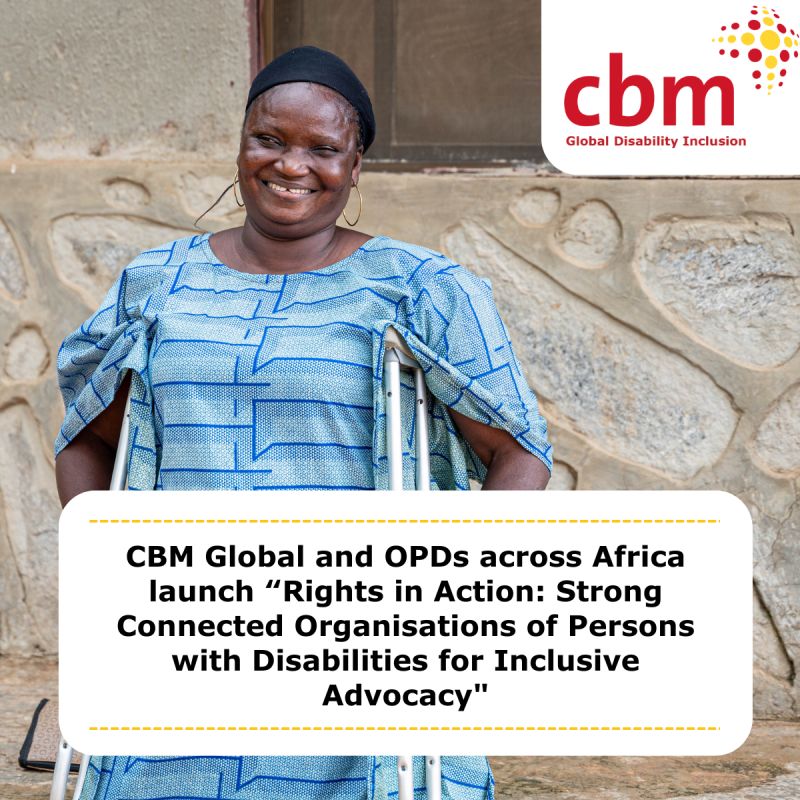
Across Africa, disability advocacy is not primarily driven by international organisations or government agencies. It is driven by communities by organisations of persons with disabilities that operate with limited resources, enormous determination, and an intimate understanding of the daily realities their members face. The challenge, always, is how to strengthen these organisations so that their advocacy can achieve lasting change.
This is exactly the challenge that CBM Global’s Rights in Action project is designed to address. Funded by the Ministry of Foreign Affairs of Finland and running until December 2026, Rights in Action is operating in Nigeria and Zimbabwe; two countries where the disability rights movement has shown remarkable resilience but continues to face significant structural barriers.
About CBM Global
CBM Global is one of the world’s largest international disability and development organisations, with roots dating back to 1908. Operating under the principle of inclusion, the organisation works with local partners across Africa, Asia, and Latin America to ensure that persons with disabilities are included in all aspects of community and national life. CBM Global’s approach is explicitly linked to the Convention on the Rights of Persons with Disabilities and, in the African context, to the African Disability Protocol.
In Africa, CBM Global works with a wide range of partners including national OPDs, healthcare facilities, academic institutions, and government bodies. Its programming spans health and rehabilitation, inclusive education, livelihood development, and crucially advocacy capacity building.
What Rights in Action Does
Rights in Action is a disability rights advocacy project with a particular focus on groups that are often underrepresented even within the disability rights movement itself. The project gives specific attention to people with intellectual and psychosocial disabilities, deaf and deafblind individuals populations whose advocacy needs are frequently overlooked in broader disability campaigns that tend to centre more visible physical or sensory disabilities.
In Nigeria
Nigeria is home to Africa’s largest population, and the Joint National Association of Persons with Disabilities (JONAPWD) is the country’s leading umbrella body for OPDs. The country has a formal legal framework for disability rights the Discrimination Against Persons with Disabilities (DAPD) Act was signed into law in 2019 but implementation has been slow and uneven across the country’s 36 states and Federal Capital Territory.
Rights in Action in Nigeria supports OPDs in building their institutional capacity: developing governance structures, strengthening financial management, building skills in evidence-based advocacy, and connecting local organisations to regional and international advocacy processes including the African Disability Protocol implementation framework. The project also works to ensure that the voices of people with intellectual and psychosocial disabilities who are often excluded from OPD leadership are genuinely represented in advocacy processes.
In Zimbabwe
Zimbabwe has a long and distinguished history of disability advocacy. The National Association of Societies for the Care of the Handicapped (NASCOH) has been a leading voice in the country for decades. The Zimbabwe Disability Arts Online (ZDAO) has pioneered disability arts and culture as a vehicle for social change. And Zimbabwe was one of the early ratifying states of the African Disability Protocol.
Despite this, persons with disabilities in Zimbabwe face compounding challenges: an economy that has struggled with severe inflation and unemployment, a health system under significant pressure, and social attitudes that continue to limit access to education and livelihoods. Rights in Action in Zimbabwe focuses on strengthening OPDs’ ability to advocate for implementation of the African Disability Protocol at national level, building coalitions across different disability constituencies, and ensuring that persons with disabilities are visible participants in Zimbabwe’s broader human rights dialogue.
The Importance of Spotlighting Underrepresented Groups
One of the most significant aspects of Rights in Action is its explicit focus on intellectual and psychosocial disabilities and on deaf and deafblind communities. These groups face what disability scholars sometimes call ‘double marginalisation’ excluded from mainstream society because of disability, but also excluded from the disability rights movement itself because their needs and communication methods may differ from the majority.
People with intellectual disabilities are often not seen as credible self-advocates, even within OPDs. People with psychosocial disabilities face stigma that is, in some contexts, even more intense than that faced by people with physical disabilities. Deaf individuals who use sign language may be excluded from advocacy processes conducted entirely in spoken language and written text. Deafblind individuals face the most severe access barriers of all.
By actively designing a project that centres these groups, CBM Global and its partners are sending an important message to the broader disability movement: inclusion must mean everyone, not just the most visible or most organised constituencies.
What Success Looks Like
For a project like Rights in Action, success is not measured in a single dramatic policy change. It is measured in the gradual strengthening of organisations that will still be advocating for disability rights long after the project ends. Success means an OPD in Abuja that has learned how to document human rights violations and submit shadow reports to the CRPD Committee. It means a Deaf organisation in Harare that has trained its leaders in how to engage with parliament. It means a parent group for children with intellectual disabilities in Lagos that has formed a coalition with similar groups across three states.
These are the building blocks of a movement. And when the African Disability Protocol’s monitoring mechanisms mature when state parties are required to report on implementation and civil society can submit parallel reports the organisations that CBM Global is strengthening today will be ready to hold their governments accountable.
📌 Find out more about CBM Global’s Africa work and partner organisations at cbm.org. If your OPD in Nigeria or Zimbabwe is interested in connecting with the Rights in Action network, reach out through CBM Global’s country offices.
Join the Conversation
At AblePath Africa, we believe that community spotlight coverage is as important as policy analysis. The disability rights movement across Africa’s 54 nations is built on the courage and persistence of local organisations and the people they serve.
Do you lead or work with a disability organisation in Africa? We want to hear your story. Whether it is a breakthrough advocacy win, a community programme that is changing lives, or a challenge you are navigating and want to share with peers across the continent reach out to us. Every story of disability inclusion in Africa deserves to be told.