

NCPWD Commences Nationwide Accessibility Checks in Tertiary Institutions
Introduction A Landmark Step Toward Campus Inclusion
For students with disabilities navigating Nigeria’s universities and polytechnics the journey to a lecture hall can begin long before the first class it begins at the gate at the staircase at a door that was never designed with them in mind That reality is now squarely in the crosshairs of Nigeria’s National Commission for Persons with Disabilities which has commenced a drive to audit and enforce accessibility standards across tertiary institutions in the country
The initiative follows years of groundwork by the Commission and draws its authority from the Discrimination Against Persons with Disabilities Prohibition Act 2018 and the Persons with Disabilities Accessibility Regulations 2023 Federal University Lafia has emerged as a landmark reference point in this push widely cited by NCPWD’s Executive Secretary Hon Ayuba Burki Gufwan as the kind of model every Nigerian university should be working toward For persons with disabilities disability rights advocates and stakeholders across the continent this is more than a compliance exercise it is a signal that the era of aspirational policy without accountability may be drawing to a close
What Is the NCPWD
The National Commission for Persons with Disabilities was established pursuant to section 31 of the Discrimination Against Persons with Disabilities Prohibition Act 2018 which was signed into law on January 17 2019 by former President Muhammadu Buhari The Act empowered the Commission to promote protect and prioritize the rights of persons with disabilities and to further enhance their productivity through education health and other socioeconomic activities of the state The Commission operates under the supervision of the Federal Ministry of Humanitarian Affairs Disaster Management and Social Development
The NCPWD’s Accessibility Department is specifically mandated to develop promulgate and monitor the implementation of minimum standards and guidelines for the accessibility of facilities and services open or provided to the public The department organises sensitisation and awareness programmes across all six geopolitical zones of Nigeria on issues of accessibility to public facilities by persons with disabilities and has developed a policy document on accessibility standards to ensure compliance and enforcement
The Accessibility Problem in Nigeria’s Tertiary Institutions
Before examining the checks themselves it is important to understand the gap they are designed to close
Nigeria has an estimated 35 million persons with disabilities roughly 15 percent of the population according to NCPWD This represents a market larger than many African countries’ entire populations yet their needs remain largely invisible across public institutions
A 2022 Agora Policy study found that more than 98 percent of public buildings across the country still failed basic accessibility standards Many states sat outside compliance The gap between legislation and lived experience was wide
In the higher education space the challenges are just as stark Research has consistently documented inadequate assistive technologies inaccessible digital platforms and weak awareness of national disability policies among both students and staff Physical accessibility remains equally problematic Ramps accessible toilets tactile pathways accessible lifts Nigerian Sign Language interpretation and disability-friendly parking remain absent or inadequate in a large portion of institutions For a student using a wheelchair or a student who is blind or deaf these are not minor inconveniences they are daily exclusions that compromise the constitutional right to education
As of 2024 only 23 out of Nigeria’s 36 states have domesticated the National Disability Act and just 15 states have operational disability agencies The scale of the gap facing tertiary institutions is set against this broader systemic reality
The Legal Framework Disability Act 2018 and Accessibility Regulations 2023
The legislative backdrop to the accessibility checks is the Discrimination Against Persons with Disabilities Prohibition Act 2018 and its companion instrument the Persons with Disabilities Accessibility Regulations 2023 Together these represent Nigeria’s most significant disability rights framework
NCPWD’s Executive Secretary Hon Gufwan has emphasised that the five-year moratorium provided within the Act has elapsed making its full enforcement a national priority He noted that for the Act to achieve its intended impact nationwide awareness and institutional compliance are indispensable
The Commission has unveiled three key certificates aimed at driving full implementation of the Disability Act 2023 and the Accessibility Regulations 2023 these are the National Accessibility Compliance Certificate the National Disability Compliance Certificate and the Provisional Accessibility Compliance Certificate Executive Secretary Gufwan described the initiative as a concrete step toward enforcement stating that accessibility is essential for persons with disabilities to participate fully in every aspect of life
The Act among its key provisions mandates a 5 percent employment quota for persons with disabilities across public institutions empowers NCPWD to investigate accessibility violations and pursue remedies prohibits all forms of discrimination on the basis of disability and promotes inclusive education and the provision of assistive technologies
Federal University Lafia A Model for the Nation
One of the clearest and most publicly celebrated illustrations of what NCPWD is benchmarking institutions against is the Federal University Lafia in Nasarawa State
NCPWD’s Executive Secretary hailed the Vice Chancellor and management of Federal University Lafia for inculcating disability-inclusive initiatives and called on other institutions of higher learning to emulate the university The Commission specifically commended the university’s 75 percent subsidy on student fees and charges for students with disabilities which has significantly reduced financial burdens and barriers to quality education The university’s 2 percent special admission policy for candidates with special needs was cited as an example of institutionalised equity in academic access The establishment of a Centre for Disability Studies was described as a visionary step toward advancing disability research training and advocacy in Nigeria The Commission also highlighted the university’s provision of accessible accommodation for students with special needs as reflecting a deep understanding of the importance of dignity safety and comfort in student life
NCPWD is currently working with 13 universities in Nigeria on possibilities of incorporating disability needs into their curriculum with a Sign Language programme having commenced at Federal University Lafia with the hope that other universities will soon integrate similar programmes
The university’s example is now being used as a practical standard against which the nationwide checks are calibrated
What the Checks Cover
Drawing on NCPWD’s Accessibility Department mandate and mainstreaming framework the inspections evaluate a comprehensive range of inclusion indicators across institutions
In the physical and built environment assessments cover availability and quality of ramps and accessible entry points accessible toilets and bathrooms lifts with visual audio and tactile features non-slippery floor surfaces accessible parking spaces tactile walking paths and guiding systems and signage including Braille and visual cues
On ICT and digital accessibility checks examine university website accessibility for screen readers availability of digital materials in accessible formats and the presence of assistive technologies such as screen readers magnifiers and Braille displays in libraries and computer labs
For academic and administrative inclusion assessments look at availability of materials in Braille audio and large print Nigerian Sign Language training for academic and administrative staff the existence and operationalisation of disability inclusion committees a formal Disability Policy and evidence of its implementation and disability mainstreaming action plans
Employment compliance is also assessed including whether the institution meets the 5 percent employment target for staff with disabilities and whether non-discrimination practices are followed in recruitment promotions and placements
Student support services are reviewed for linkage with NCPWD bursary and scholarship support HELB-equivalent financial support for students with disabilities and disability-inclusive placement and guidance services
NCPWD and the National Universities Commission
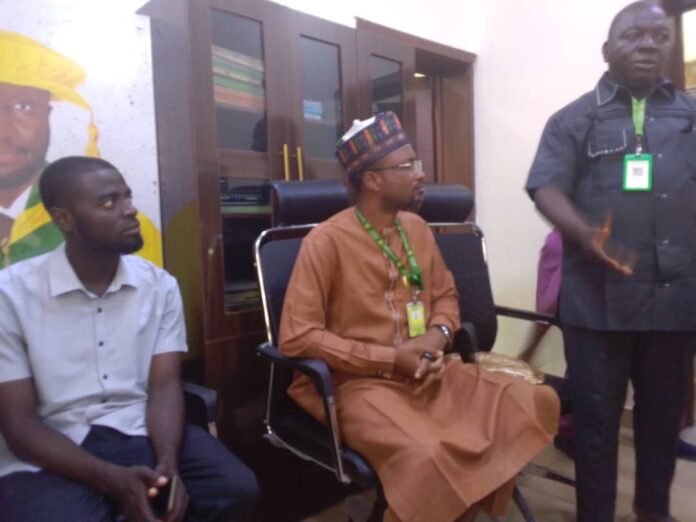
A delegation from NCPWD led by its then Executive Secretary visited the Acting Executive Secretary of the National Universities Commission to discuss critical matters affecting persons with disabilities in Nigerian universities The NUC Acting Executive Secretary acknowledged that the Commission had through its Directorate of Students paid regular visits to universities to assess the status of student support facilities and had consistently recommended that universities redesign their programmes and physical facilities to accommodate persons with disabilities He pledged that the NUC would make a formal proposal process available to NCPWD on areas of intervention and reiterated the NUC’s readiness to promote inclusiveness
This institutional collaboration between NCPWD and the NUC forms the regulatory backbone of the accessibility drive ensuring that universities are not only inspected but guided toward genuine structural reform
National Accessibility Compliance Certificates A New Accountability Layer
A pivotal development accompanying the accessibility checks is the introduction of the National Accessibility Compliance Certificate framework
NCPWD has introduced the National Accessibility Compliance Certificate a requirement that is transforming how banks malls schools government offices and private establishments approach inclusion Ramps must be built before the cement sets Doors and office corridors must be widened With support from groups like Sightsavers the Commission is conducting accessibility audits training staff and guiding new designs
For tertiary institutions this certificate framework means that accessibility is no longer a soft recommendation it is a measurable compliance requirement with institutional accountability attached to it Institutions that obtain the certificate signal to students prospective staff and partners that they are genuinely committed to inclusion Institutions that fail to pursue compliance risk being found in violation of the Disability Act 2018 with the Commission’s enforcement powers now fully in effect
The Broader African Context
Nigeria’s move is not happening in isolation Across Africa the gap between disability law and campus reality remains a defining challenge in higher education
The African Union Commission in its November 2025 engagement with NCPWD recognised Nigeria’s unique position as a regional leader in disability legislation and institution building affirming that the AU views Nigeria as a reference point for other African countries seeking to domesticate and implement the African Disability Protocol The delegation acknowledged NCPWD’s ongoing efforts in nationwide accessibility audits inclusive employment frameworks and data harmonisation
In South Africa the Higher Education Disability Services Association continues to work with universities to audit and improve disability inclusion though significant gaps remain In countries including Ghana Ethiopia and Uganda inadequate infrastructure limited educator training and deep-seated stigma continue to undermine inclusion frameworks What makes Nigeria’s initiative particularly significant is that it is state-led backed by law and now tied to a certificate-based accountability mechanism This positions it as a potential continental model for moving from disability rights rhetoric to measurable institutional change
What This Means for Students with Disabilities
For the millions of Nigerians with disabilities currently in or aspiring to enter tertiary education the nationwide accessibility checks represent both a promise and a test
The promise is simple campus environments should be designed for all students A student who is blind should be able to find their way to the library A student using a wheelchair should be able to access their lecture hall A student who is deaf should have a sign language interpreter in the classroom A student with a visual impairment should be able to access course materials in a format that works for them These are not special privileges they are rights
The test is whether the checks will be followed through The historical pattern across Africa and indeed globally is for inspection exercises to yield reports that gather dust Advocates and disability-led organisations in Nigeria will be watching closely whether findings translate into enforceable timelines resource allocation and genuine institutional transformation
Recommendations for Tertiary Institutions
To assist institutions in preparing for and going beyond NCPWD’s checks the following steps are recommended based on the Commission’s mandate and accessibility framework
Establish a Disability Inclusion Committee with meaningful representation from persons with disabilities and develop a Disability Mainstreaming Action Plan with clear timelines and budget allocations Audit all physical infrastructure for accessibility gaps and develop a remediation roadmap Invest in assistive technology for libraries computer labs and learning management systems Provide Nigerian Sign Language training for frontline academic and administrative staff and ensure course materials are available in accessible formats including audio large print and digital-accessible documents Review and update the institution’s Disability Policy for content implementation and student awareness Apply for the National Accessibility Compliance Certificate and engage with NCPWD’s compliance framework directly Meet the 5 percent employment target for staff with disabilities in all recruitment rounds and engage students with disabilities directly in designing and reviewing accessibility measures
Conclusion From Policy to Practice
The NCPWD’s nationwide accessibility checks in tertiary institutions are a defining moment for disability inclusion in Nigeria and potentially a model for the rest of Africa They represent the practical activation of the Disability Act 2018 and the Accessibility Regulations 2023 laws that are no longer content to sit on the shelf but insist on being lived out in corridors classrooms laboratories and lecture halls
For AblePath Africa this story is about more than buildings and ramps It is about the dignity and full citizenship of persons with disabilities in spaces of knowledge and opportunity It is about the right of every student regardless of ability to pursue education without having to fight for access at every step
Federal University Lafia has shown what is possible Now every other institution in Nigeria has a responsibility to ask itself why it has not done the same
The checks have begun Now the work of genuine transformation must follow.
AblePath Africa is a platform dedicated to news rights, opportunities and inclusion for persons with disabilities across the African continent For more information on NCPWD services visit ncpwd.gov.ng