

Africa’s Assistive Technology Revolution: From Hackathons to National Laws, a Continent Is Waking Up

Globally, an estimated 2.5 billion people need at least one assistive product; from hearing aids and wheelchairs to screen readers and prosthetics. That figure is projected to rise to 3.5 billion by 2050 as populations age and the prevalence of chronic conditions grows. And yet, in the WHO African Region, only about 15 to 25 percent of people who need assistive products can access them.
That gap between need and access represents one of the defining disability justice challenges of our time in Africa. But something is changing. Across the continent, a new generation of innovators, policymakers, investors, and disability advocates is beginning to build the ecosystem needed to close it.
Why Africa Needs Locally Built Solutions
For decades, assistive technology available in Africa was largely imported from the Global North — expensive, often poorly suited to local environments, and dependent on supply chains that break down easily. A wheelchair designed for smooth pavements in a European city may be useless on unpaved rural roads in Uganda. A hearing aid calibrated for English may not work effectively with tonal languages. Software designed with Latin scripts may not support African languages at all.
This mismatch between available technology and local reality is not merely an inconvenience it is a barrier that keeps millions of Africans with disabilities from independence, education, and employment. Research on scaling assistive technology innovations in African markets highlights the importance of modular, versatile, and customisable solutions that can adapt to highly varied contexts without requiring massive additional investment.
Ghana’s DI-Hack: Building AT from the Ground Up
One of the most exciting initiatives in Africa’s assistive technology space is the Disability Inclusive Hackathon known as DI-Hack organised by Inclusive Tech Group Ghana. Now in its fifth year, the event was held in November 2025 at the University of Ghana, bringing together tech developers and persons with disabilities to design assistive technologies built specifically for African realities.
The 2025 top prize went to SMARTi, which developed EchoSign — a real-time sign language translation tool designed specifically for Ghanaian Sign Language. EchoSign works offline, offers both sign-to-text and text-to-sign translation through a 3D animated avatar, and is designed for environments with low or no internet connectivity. This is a crucial feature for the majority of Africans with disabilities, who live in rural areas where data connectivity is unreliable.
Second place went to FPE (Funability Inclusive Park and Equipment), which developed inclusive playground equipment allowing children with physical disabilities to play alongside their non-disabled peers incorporating sensor detectors, pressure-sensitive LEDs, audio feedback, vibration pads, and remote-control operation for multi-sensory adaptive play.
Since 2020, Inclusive Tech Group has trained more than 400 persons with disabilities across Ghana in digital literacy, ICT skills, and digital marketing. Their inclusive technology lab at the University of Mines and Technology, established with support from AngloGold Ashanti, is building long-term infrastructure for inclusive learning.
Kenya’s Landmark Persons with Disabilities Act 2025
Kenya is taking the policy dimension of assistive technology seriously. The recently passed Persons with Disabilities Act 2025 introduces a rights-based framework that formally recognises assistive technology as an essential service not a luxury, not a charitable provision, but a legal entitlement. The law mandates public-sector support for AT provision, including subsidies, employer inclusion requirements, and improved cross-government coordination.
This legislative reform provides the foundation for a sustainable assistive technology ecosystem. Without legal recognition, AT remains dependent on donor funding and NGO goodwill. With it, there is a legal basis for budget allocations, procurement mandates, and enforcement.
The Inclusive Africa Conference 2026, scheduled for Nairobi as a hybrid event, will build directly on this momentum, focusing on accelerating digital accessibility and AI solutions for Africa’s future. The conference brings together policymakers, technologists, innovators, researchers, and advocates to explore accessible technology, assistive tech innovations, inclusive AI, and digital inclusion across the continent.
The Global Disability Innovation Hub and Africa’s AT Accelerator
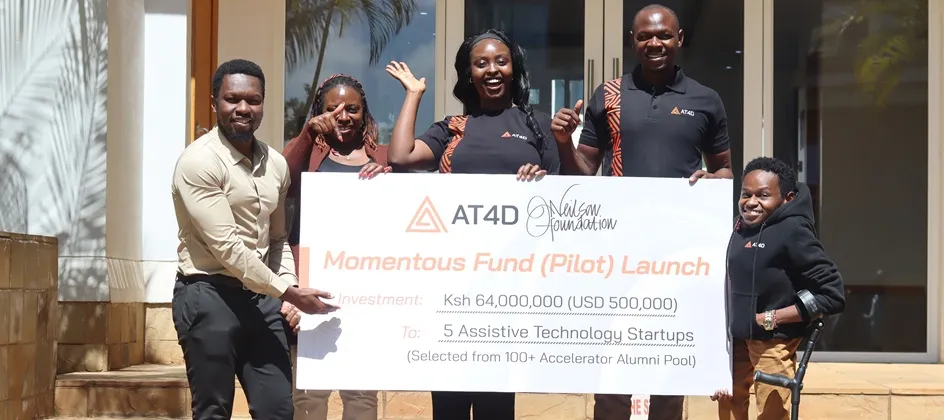
In June 2025, the Global Disability Innovation Hub (GDI Hub), Assistive Technologies for Disability Trust, Kilimanjaro Blind Trust Africa, and Senses Hub co-hosted a major event in Nairobi titled ‘Accelerating Impact: Shaping the Next Wave of Assistive Technology Innovation in Africa’. Funded by NORAD and held immediately after the Inclusive Africa Conference, the event brought together AT innovators from Kenya, South Africa, Ghana, Nigeria, and Tanzania alongside policymakers, investors, and international development partners.
GDI Hub also presented research findings on mobile as assistive technology exploring how mobile devices, when combined with digital skills training, can serve as AT platforms for persons with visual, hearing, and physical impairments. Given the widespread availability of mobile phones across Africa relative to specialised AT devices, this work has significant implications for scaling accessibility at low cost.
The Centre for Digital Language Inclusion (CDLI), led by GDI Hub, is developing AI innovation to enable people with non-typical speech to use voice-first technology in African languages. This addresses a critical gap: most voice recognition systems are trained on standard speech patterns and do not work reliably for persons with speech impairments or for speakers of minority African languages.
CHAI and the LEGO Foundation: Early Childhood AT in Africa
The Clinton Health Access Initiative (CHAI) is partnering with the LEGO Foundation in eight African countries: Ethiopia, Kenya, Liberia, Nigeria, Rwanda, Sierra Leone, and South Africa to empower children with disabilities to play and learn through early access to assistive technology. CHAI has worked with five African countries to launch their first-ever national priority assistive products lists, achieved a 50 percent price reduction for eyeglasses by establishing a more efficient supply chain, and supported six countries in launching strategies to increase AT access.
In Rwanda, Georgia Tech’s Global Assistive Technology Innovation (GATI) Hub is working with local partners on human-centred, locally driven assistive technology design. Recognising that simply shipping technology from the Global North is a short-sighted solution, GATI brings students from Computer Science, Biomedical Engineering, Industrial Design, and Public Policy together to design AT with Rwandan communities, not for them.
📌 Less than 3% of people with disabilities in Sub-Saharan Africa have access to the AT they need (WHO). This is not a technology problem, it is a systems problem. The solutions exist. What is needed is investment, policy, and local manufacturing capacity.
What Still Needs to Change
Despite the remarkable momentum, significant challenges remain. Most AT innovations from African hackathons and accelerators struggle to scale beyond prototype stage because of weak investor ecosystems, limited regulatory frameworks for medical devices, and the challenge of building distribution networks across vast and geographically diverse markets.
A frank reflection published by disability inclusion professional Olusola Owonikoko in October 2025 asks a pointed question: ‘Who bridges the gap for the people building the bridges?’ African AT innovators get celebrated at conferences but too few receive the sustained support, capital, and market access they need to turn prototypes into products that reach the people who need them.
Closing Africa’s AT access gap will require national governments to follow Kenya’s lead in recognising AT as an essential service, regional bodies to develop shared procurement mechanisms, investors to treat AT as a viable market rather than a charity sector, and the disability movement to hold all of these actors accountable. Africa is waking up. The next decade will tell whether this moment becomes a movement.